
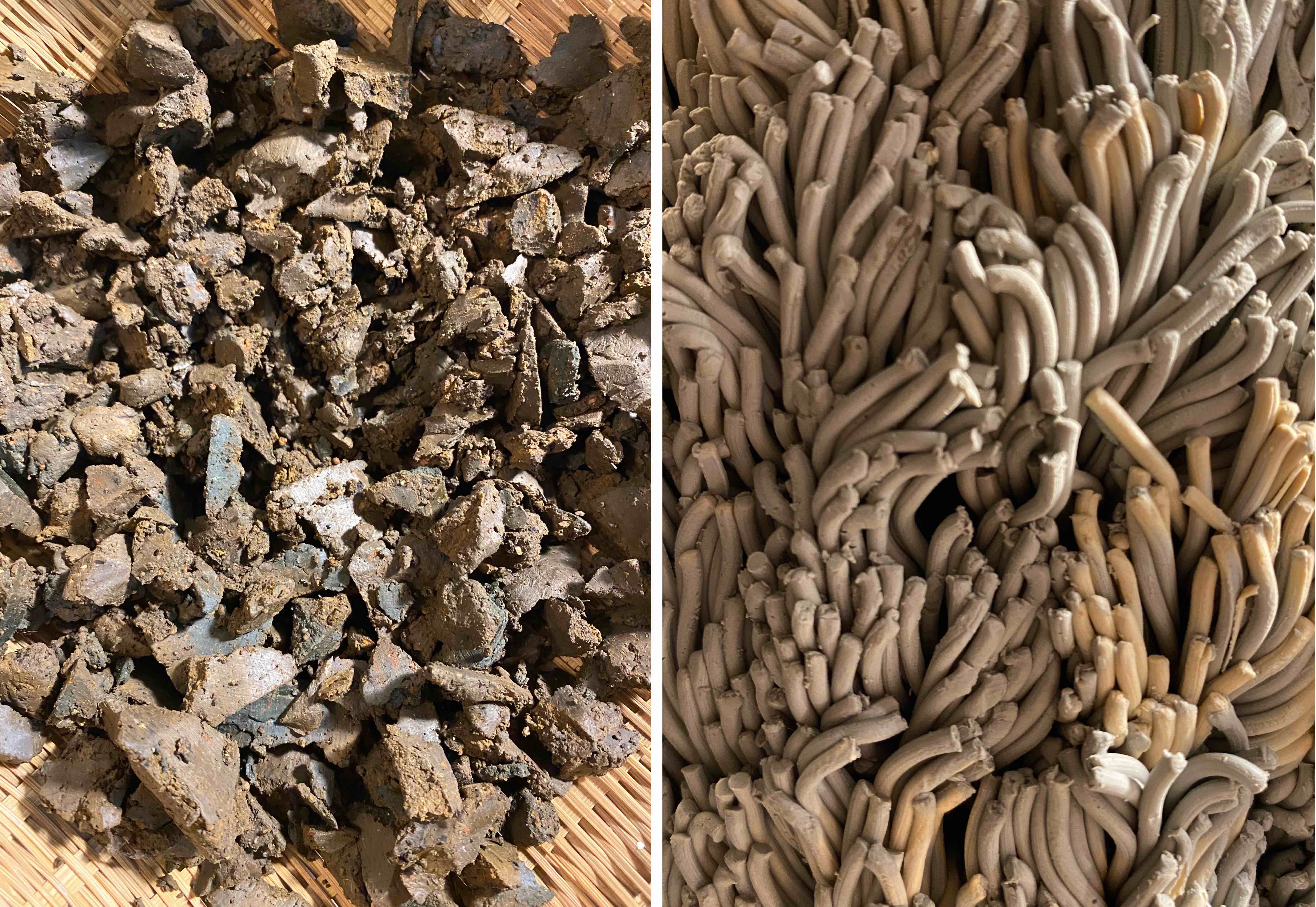
Cartellino Digest launches Resonances, a series of essays written alongside recently concluded and ongoing exhibitions in our physical space. Contributed by artists whose practices intersect with the concurrent exhibition, each essay expands on the discourse set forth by the show through tangents in medium, personal experience, artistic style, among others.
For its inaugural essay, Resonances features ceramic artist Jezzel Wee, who reflects on the imprints made by the processes of pottery-making. From gathering, preparing, forming, and firing clay, Wee frames these stages as records of both archaeological history and an artist’s gestures—broad and personal hesitations and convictions that go into shaping pottery.
The essay was written parallel to Kanlungan, the recently concluded exhibition of Rita Badilla-Gudino, which was on view at Cartellino last September.
A wooden table, soft clay, toggle wire, subtle scent of incense and hum of the electric fan.
Pottery is one of the humblest of man’s arts. It is best when it is most earth-honest; that includes process-honest, fire-honest, honesty of being itself.1 Perhaps, the practice itself is grounded in this human virtue.
The process seems very simple, yet complex: gathering clay between the hands, holding it firmly, and wedging it softly against the wooden surface. It leaves marks—traces of moisture onto the wood. The cycle goes on sixty times, and if you listen carefully, you will hear the faint popping sounds of the air pockets trapped in between the clay. Attention to preparing the clay is essential, there is no room for impatience and shortcuts. Although this is just one part of the making process, it is the most important of them all. Working with clay is composed of small movements that greatly contribute to the outcome. A form may have been conceptualized, but it is temporarily shelved to the back of the mind to be able to be present in the preparations.
Clay weathered from the mountains, travelled through pressure, erosion, water systems, then eventually discovered and harvested. A once-hard material becomes soft, malleable, vulnerable, ephemeral, and temporary until it undergoes firing—making it hard and permanent again. Every type of clay has a unique mineral composition that can be traced to its origin. It carries the history of its landscape and its materiality, going through a cycle that is similar with the natural processes and with the process of making. Working with clay comes with acknowledging and carrying that history. It is one of the oldest materials used by man to create vessels and figures. They are silent recorders of its creator’s intentions and hesitations.
Pottery is one of the most common types of artifacts during excavations. A small sherd can tell a whole story—a recorder of the potter’s intent and decision-making. It is a glimpse into the past, a vestige of history. It is something that is permanent yet ephemeral, a duality which characterizes its materiality and has been utilized from prehistory until the present.
One of the oldest pottery here in the Philippines is the Manunggul Jar, a secondary burial jar excavated from the Manunggul Cave of the Tabon Caves at Lipuun Point in Quezon, Palawan. It dates from 890-710 BCE; on top of the jar are two figures that represent the soul’s journey to the afterlife and incised decorations of waves and stars. Another example of prehistoric pottery found here in the Philippines is the anthropomorphic burial jars in Maitum, Sarangani. The Maitum Jars display individualized facial expressions and features, an early attempt to imbue these burial jars with humanistic features. Complex designs from the Kalanay Pottery Complex in Masbate share similarities to the Sa Huynh culture in Southern Vietnam.
From burial jars, ritual vessels, to utilitarian earthenware, the Philippines has a rich history in ceramics. At present, some of the traditional pottery communities in places like Vigan, Ilocos Sur, Pampanga, Tiwi, Albay, Kalinga, and Mountain Province continue to use and shape local clay using forming and firing techniques passed down through generations.
Our long history of pottery-making deserves attention and reflection. Historic pottery sites are all over the country; some are still producing market potteries, but some are barely making ends meet. This raises questions on how the practice can be sustained beyond economic means. The local pottery industry outside Metro Manila needs more exposure and more support. Learning and integrating its significance will strengthen the industry, but it needs active research and partnerships with LGUs, state universities, and other stakeholders.
It’s a different case within Metro Manila and nearby provinces; pottery studios are growing in numbers, each with their own unique interpretation of pottery as discipline. Some expand with haste but some focus more on steady and firm foundations. One may seek learning from multiple teachers that will equip them with useful tools and a particular set of skills to hone, which can be refined according to the individual’s needs. But learning does not stop there—taking the path to pottery is a lifelong journey, full of excitement and heartaches. As Philippine ceramic practice continues to grow from traditional to contemporary, the core of the medium remains unchanged. A fired vessel remains an honest archive of intentions, keeper of both personal and collective histories. It continues to transcend the boundaries of its maker, to be handled, preserved, or reinterpreted by future generations.
Clay is simultaneously one of the most forgiving and one of the strictest materials to work with. It records every hesitation and every conviction of the maker. To work with this medium requires commitment to a lifelong persistence, an understanding that mastery is earned across a million tries. It demands patience as one learns how to enter into a dialogue with the material. Over time, the hands learn to listen as much as they lead, a balance of control and acceptance of the natural physical limitations. The discipline is shaped by intentions and is reflected in the forms.
Acknowledging the past histories to the present, the vital inquiry for us is, “How do we want to shape the discipline here in the Philippines?”
Do we remain sincere with our intentions? How do we stay grounded in our local soil, become globally competitive, yet still honour the million tries of those who came before us? Do we need to be globally competitive or do we need to strengthen our local ties and connections, or both? In what direction are we taking the discipline?
Personally, I look forward to the forms that we will create and the conversations that we will share and shape together.
References
[1] Beittel, Kenneth R. 2019. Zen and the Art of Pottery. Weatherhill, 1989.
Further Reading
Fox, R. B. (1970). The Tabon Caves : archaeological explorations and excavations on Palawan Island, Philippines. In National Museum eBooks. http://ci.nii.ac.jp/ncid/BA33619107
Livingstone, A., & Petrie, K. (2017). The Ceramics Reader. In Sunderland Repository (University of Sunderland). http://sure.sunderland.ac.uk/view/creators/Livingstone=3AAndrew=3A=3A.html>
Scheans, D. J. (1977). Filipino market potteries. In Medical Entomology and Zoology. http://ci.nii.ac.jp/ncid/BA59891958
Solheim, W. G. (1964). The Archaeology of Central Philippines. A study chiefly of the Iron age and its relationships.
Solheim, W. G., & Paz, V. (2004). Southeast Asian archaeology : Wilhelm G. Solheim II festschrift. In University of the Philippines Press eBooks. http://ci.nii.ac.jp/ncid/BA76410965
Jezzel Wee finds inspiration in the complexities of organic forms, creating works meant to be felt, held, and experienced in response to the shifting rhythms of our transforming world. A ceramic artist and educator, she served as the Ceramics Studio Coordinator from 2023-2026 at the University of the Philippines College of Fine Arts in Diliman, where she also graduated Magna Cum Laude. She completed a three-year apprenticeship at the Tsugaru Kanayama Pottery in Aomori, Japan.
Her practice weaves together art-making and archaeology, as she divides her time between creating artworks, studying for her graduate studies degree in Archaeology, and exhibiting in Australia, Japan, Thailand, and various art spaces and institutions across the Philippines. She was selected for ArtFairPH/Special Projects in 2025, and her solo exhibition, "To Weigh Seeds, Pulling Through," is shortlisted for the 2025 Ateneo Art Awards (AAA) Fernando Zóbel Prizes for Visual Art.
Images courtesy of Jezzel Wee