
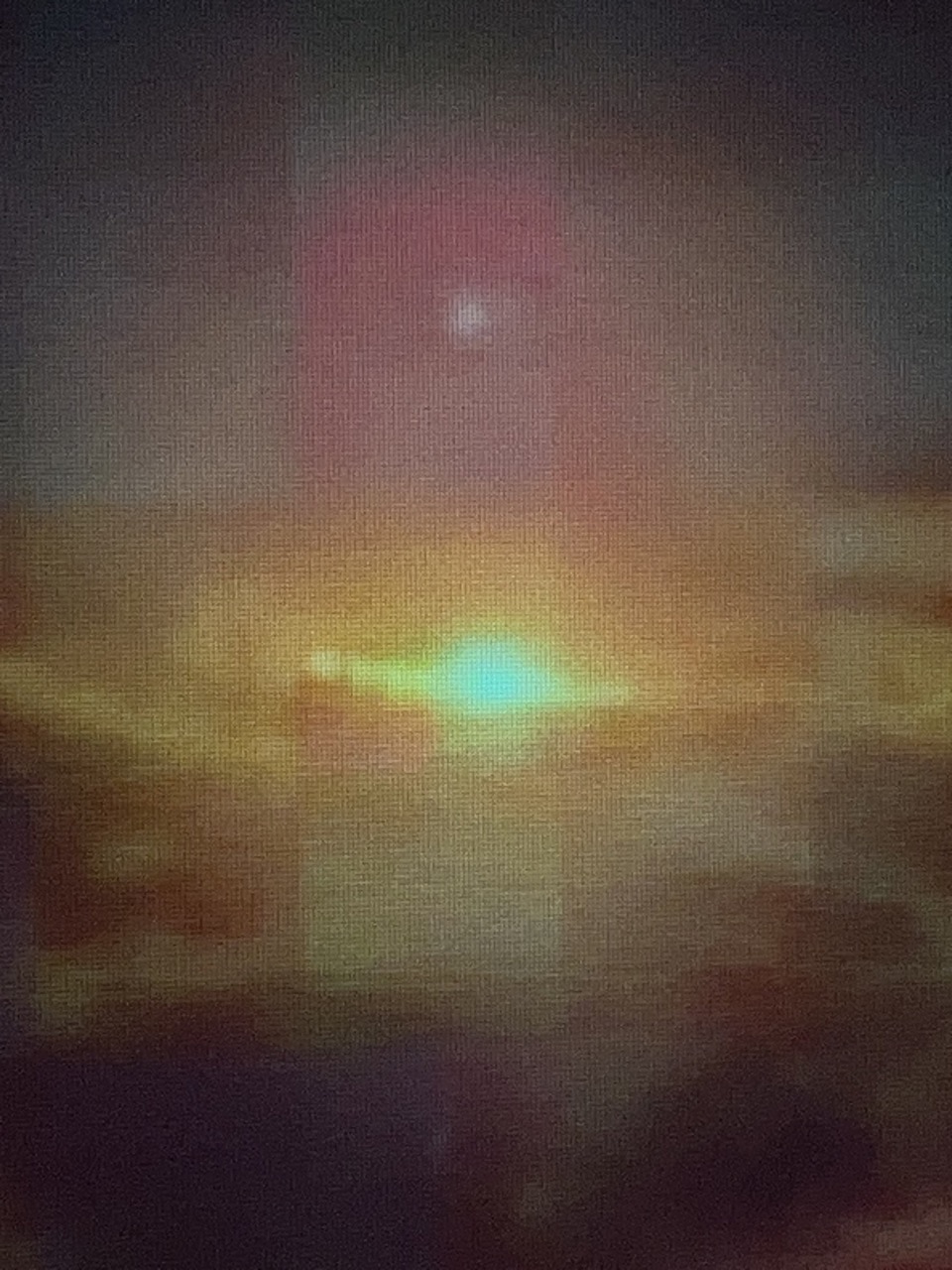
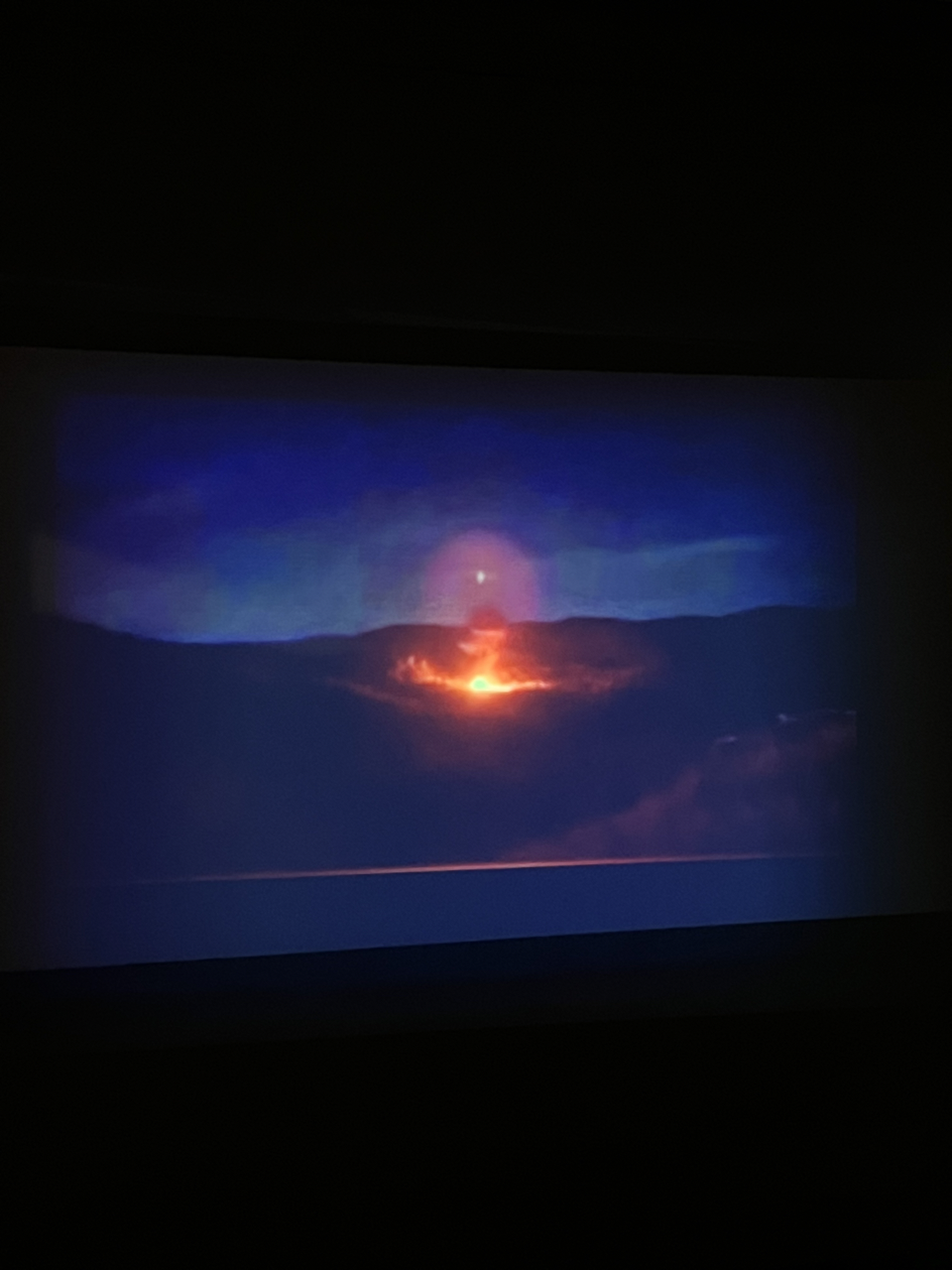
We reached the gallery in the middle of the missile’s detonation. Running from August 14 to August 29, 2026, "An Explosion in Slow Motion" by Levi Masuli is a 192-hour-long video and sound installation at the corner of WHYNoT in Makati, Metro Manila. The video shows an American Tomahawk missile launched from Leyte and landing on Nueva Ecija on May 5, 2026. By stretching out the clip into days, one can only see the aftermath of the landing: a ball of fire like a despicable sun and clouds of smoke that surround it. The boom of the impact has been distilled into an eerie ringing. The duration of the work invites viewers, for an extended period, to sit and swallow the piercing fact of America’s longstanding grip on the Philippines. Because neither me nor my companions paid for WHYNoT’s three hundred-peso pass, we were only allowed to stay for a few minutes before leaving.
The Tomahawk missile used on Philippine land, as the exhibition notes say, was the same one that the United States (US) used on their assault in Iran that killed over a hundred civilians. This juxtaposes the use of US’s firepower, that despite being the same weapon used in their conquest of West Asia, the launch from and on Philippine land is strictly for testing purposes, carrying “no explosive payload.”1 Masuli’s work, then, pivots our horrified reactions from lengthened displays of violence on local soil to inquisition; what role does the Philippines play in the ongoing conquest committed by the United States, in the various modes that empires use to expand?
Since its first occupation of the Philippines, the United States’ influence has been an enduring one. In a project “of promoting the pacification of the islands,"2 quelling native insurgencies against its hold, the United States sent the American military to work as schoolteachers in the Philippines, establishing the public school system with English as the primary mode of teaching.
Aside from the ideological imprints left by US education and other soft colonial projects, the Philippines’ intermittent yet longstanding allegiance to the US can be shown as well in the history of American military bases in the archipelago: starting in 1903 and ceasing operations in 1991 after the Philippine government did not renew their stay, American military presence returned when the United States requested the use of local military bases in 2016. In 2023, they were granted an additional four bases.3 By making symbolic and libidinal the promiscuous relations of first world countries with third world countries, scholar Neferti Tadiar unveils how a prominently wealthy and militarily powerful country such as the United States, a masculine figure, exploits the resources and labor of the Philippines, in turn a feminized figure. “In her relationship to the United States,” she writes, “the Philippines is an exploitable body, an industry hooked up to the US desiring machine through a series of flows and labor and capital in the guise of free exchange.”4 Every missile launch in foreign land by the US is assault; every penetration in ours is tepidly consensual. By calling the Philippines “the mistress” of the United States, not only is the country marked as a sponsor who gives to the US’s every whim, but simultaneously its role is marked as complicit in the growth of empire.
The Philippines’ collaboration with the United States and its allies as implied in Masuli’s work continues to hold considerable weight as the country’s contested involvement in Pax Silica, a US-led coalition to “secure supply chains for semiconductors, critical materials, and artificial technologies,”5 looms above us. Among the allies in this coalition is, of course, Israel. The Philippines’ involvement comes at the cost of a 4,000-acre data center in Tarlac that will affect the livelihood of New Clark City’s citizens in pursuit of a “US-led effort to bolster supply chains.”
This is the rub of Levi’s disturbing video and sound installation. And there is so much more insight for viewers to mine from it if they stayed and sat in longer duration with the work, a privilege I and my friends at the time could not afford. The three hundred-peso entrance fee that we were prompted by the kind receptionist was an all-in pass that, aside from being able to stay for extended lengths of time with the gallery’s artworks, included a stay-all-you-can pass at WHYNoT’s workspace.
Certainly this three hundred pesos is cheaper compared to WHYNoT’s neighboring galleries in Makati, and three hundred pesos from visitors will help operate the gallery, pay for its expenses, and compensate its staff. However, the hybrid of gallery-and-workspace can stir disturbance when Levi Masuli’s installation that depicts the horrific colors of empire sits dormant in the corner. In WHYNoT’s curated space, the sound of American violence is the low-humming soundtrack for chitchatting and doing monotonous email work. In the introduction to Theodor Adorno’s The Culture Industry, scholar of critical theory J.M Berstein says that the art market and the artworks circulating within it are “pure because [they are] unconstrained by need,”6 void of utility. Because WHYNoT operates as both a gallery and a workspace, it transforms artworks, like An Explosion in Slow Motion, into objects with exchange value, infecting it with the features of furniture to furnish an ambient experience for its workspace dwellers.
The positioning of the work may be deliberate, of course; with An Explosion in Slow Motion at the edge of the gallery space, it extends the metaphor of imperial violence and our participation in it as something looming just over the horizon. But, and I am starting to think this true, it may all be accidental.
References
- Sayson, Crisis. Us Missile Launch in Tacloban Sparks Tension During Balikatan Drills, PhilNews. Accessed 2026: https://philnews.ph/2026/05/06/us-missile-launch-in-tacloban-sparks-tension-during-balikatan-drills/
- Constantino, Renato. The Philippines: A Past Revisited, from the Spanish Colonization to Second World War, Tala Publications, 1975.
- Acosta, Rene. U.S Philippines Add Four More Sites to EDCA Military Base Agreement, U.S Naval Institute News. Accessed 2026: https://news.usni.org/2023/02/02/u-s-philippines-add-four-more-sites-to-edca-military-basing-agreement
- Tadiar, Neferti. “Sexual Economies in the Asia-Pacific Community,” from What is a Rim? Critical Perspectives on the Pacific Region Idea, ed. Dirlik, Arif, 1998.
- Castillo, Jonathan. Pax Silica, Explained. Manila Bulletin. Accessed 2026: https://mb.com.ph/2026/07/22/pax-silica-explained
- J.M Berstein, “Introduction,” from The Culture Industry: Selected Essays on Mass Culture, Routledge, 1991.
Justin Andrew Cruzana is from Manila. His poetry has appeared in TLDTD, Body Literature, and Cordite, among others.
"An Explosion in Slow Motion" was on view from 14-29 August 2026 at WHYNoT Manila.