
• Aug. 31, 2026
											stdClass Object
(
    [id] => 849
    [title] => 

Word for Word: Efren Madlangsakay Jr. on a worldview shaped by continual movement 

[slug] => 2026/08/31/Word-for-Word-Efren-Madlangsakay-Jr-on-a-worldview-shaped-by-continual-movement [body] =>

How does a life of transit shape one’s worldview and artmaking? On the first session of Art Writing for Evolving Platforms held last July 18, 2026, Efren Madlangsakay Jr. gave a talk on the conceptual, visual, and processual inspirations that influence his practice. Madlangsakay recalls a life spent on transit as key to its unfolding, interlaced with contemporary developments on technology and printmaking.

Read below for a partial transcription of the talk and the corresponding open discussion with the workshop participants.

Efren Madlangsakay Jr.: The exhibition began with hope in the idea that whatever the circumstance you may find yourself in, nevertheless, you move forward. From this, my initial inspiration was being in transit—specifically, inside a moving train. I was curious about how the decision to relinquish all control of our journey may give us both peace and anxiety. There is also the idea of being still inside something that is moving. 

https://www.instagram.com/p/Da485uKFEWx/?img_index=1

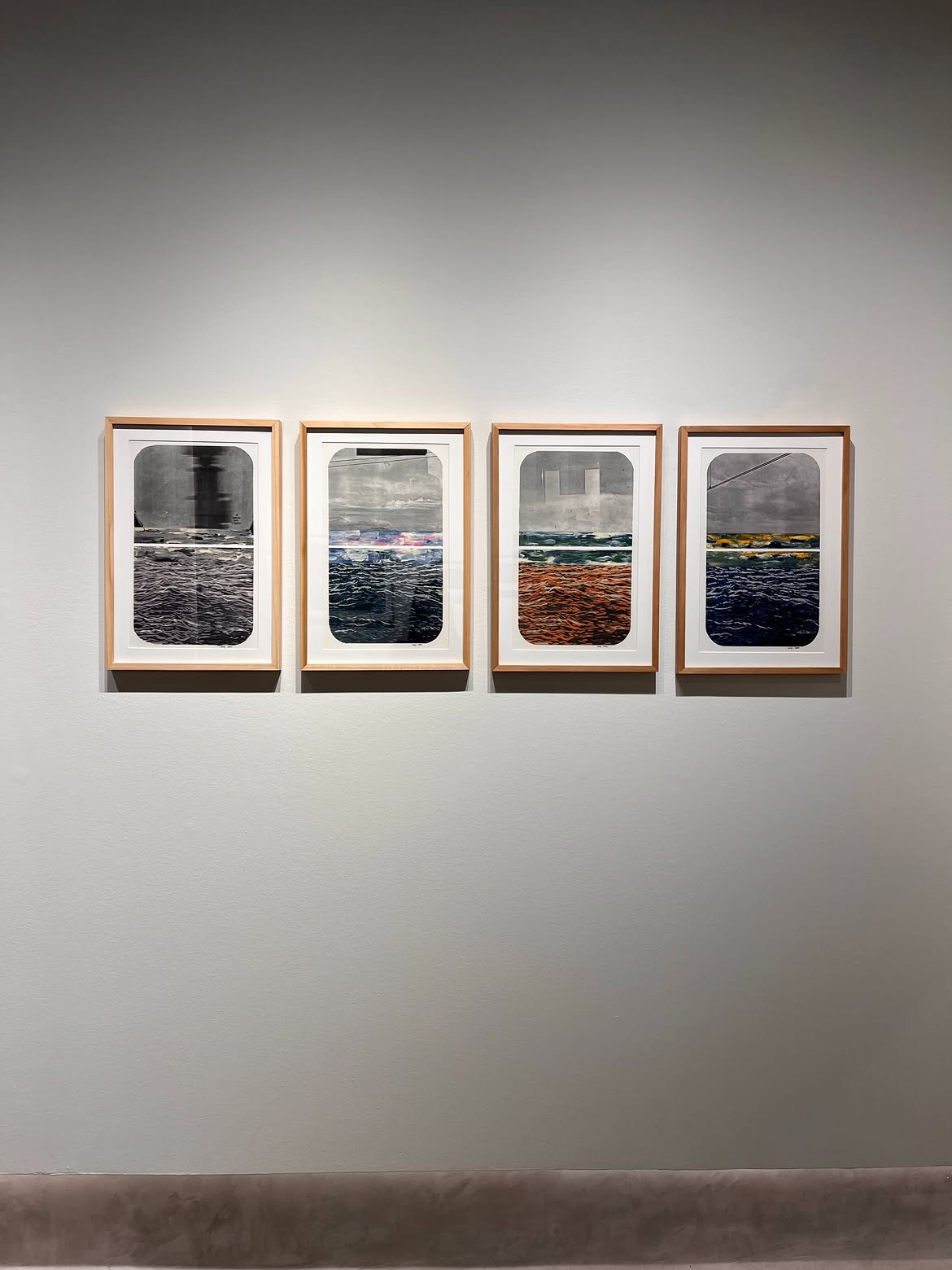
Aside from these internal contemplations, much of my inspiration is also derived from the visual experience of riding a train. When you look at my works, you will notice imagery gathered from videos taken while I was inside the vehicle. See, for instance, “Never and always too late (to behold).” There is the impression of a window reflection, as if a glass pane is obstructing one’s view. Then we have the electrical lines and posts with the sky peeking behind them. Being in transit, our appreciation and view of the natural world would always become obstructed by manmade structures. But even then, we find something beautiful from them. 

“Never and always too late (to behold),” series of four

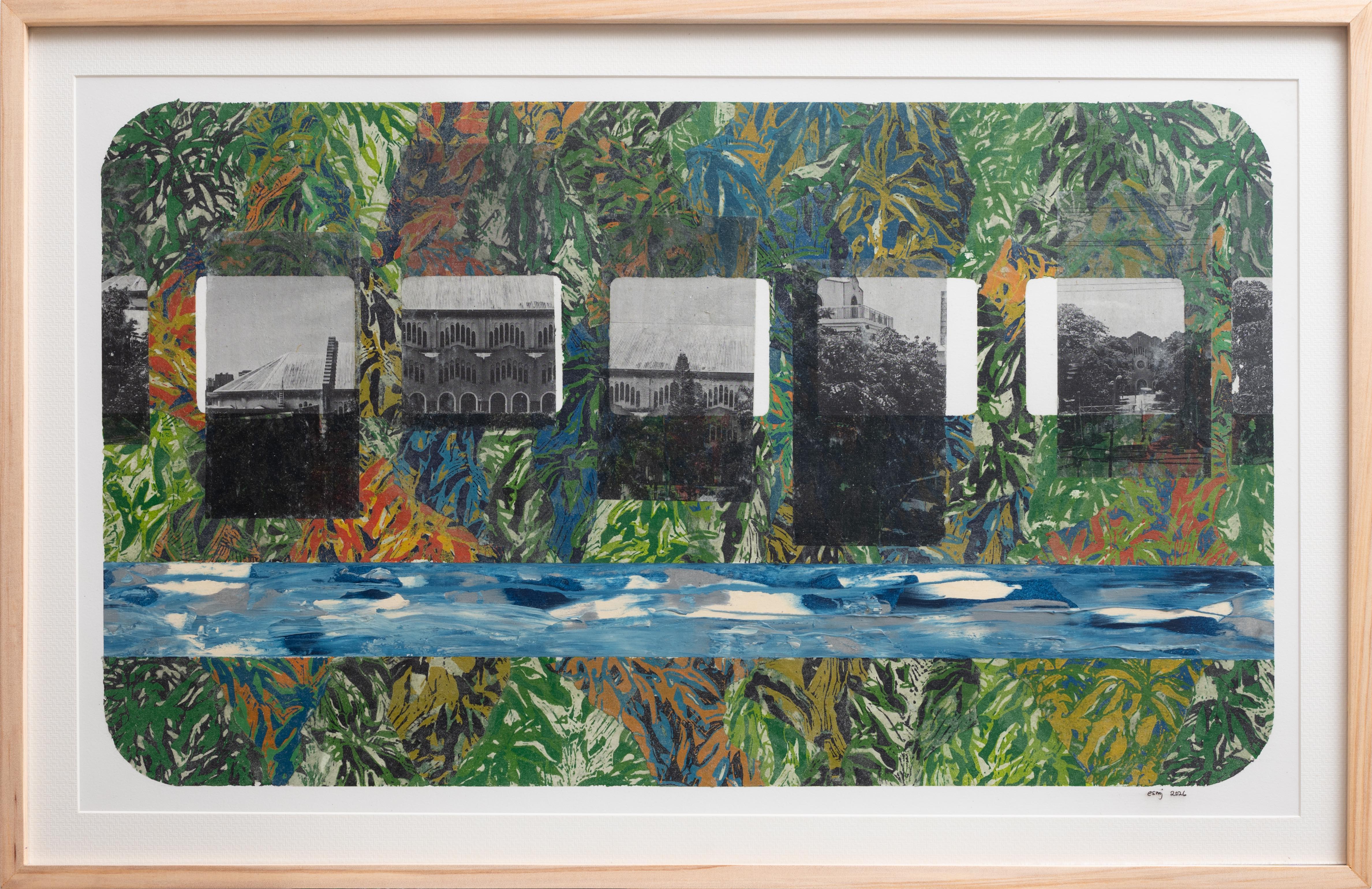
I move on to “A passing prayer,” which shows a view of the Baclaran Church. To give you some background, I was primarily drawn to the concept of transit because of its ubiquity in my personal life. I live in Las Piñas, but I studied in Quezon City. During my commutes, I would frequently pass by the area near Baclaran Church. From this, I took interest in the idea of a church as a station; when we pass by a place of worship during transit, we would make the sign of the cross or touch the rosary hanging on our dashboards. I found it interesting how travelling would provoke these actions. In addition, this piece is a good illustration of my explorations with framing. I would often use the shape of a train window as a frame. I also like to play with orientation; at times, I intentionally leave the orientation askew to capture the notion of movement.

“A passing prayer” featuring views of the Baclaran Church

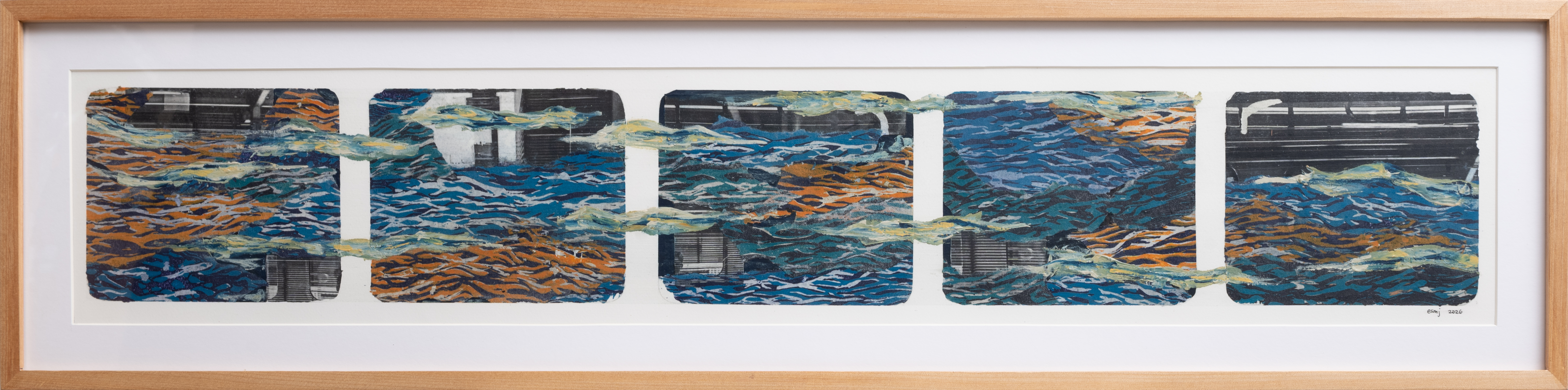
Also important to my practice are the titles I give my works. Words usually serve as my prompt. In “Embark, alight,” I played with the words’ meanings. “Embark” means to get on, like to start an adventure. Meanwhile, “alight” is more than just getting off a means of transportation; it also evokes being in somewhere new. With this, I go back to my earlier allusion to the contrasting emotions we feel while riding trains. I call this hopeful anxiety or fearful anxiety—muddled feelings within departures, arrivals, and journeys.

This next work is where the title of this exhibition originated. You will notice a sense of fullness from this titular piece, in contrast to the others that are more bounded especially with the shapes of train windows. It gives visual references to overflows across borders, similar to how we persist in moving forward even after reaching full capacity.

“Nevertheless, forward,” the titular work of the exhibition

Audience Member: How do you choose your colors?.

Artist: It’s partly intuitive. I don’t think about the colors at the start. I normally get a feel of what colors I wish to add as I see the work unfold. But I usually tend to be colorful.

Audience: I’m curious about your process. In what particular order do you layer your materials?

EMJ: I think of it like painting with rubbercut prints. Usually, I begin with photo transfer. I then press the rubbercut print onto the paper, then rub the excess paper off so that we are left with ink as residue. However, I try to leave residual pieces of paper since they contribute to the texture. The idea for this process came from test prints. As I worked with the medium, I sought a way to make use of the test prints that were piling up in my collection. Other artists, for example, extract the images from magazines using glue. The ink in printmaking is an offset printer’s ink. This is also what we use in printing magazines. I used this principle to make these works.

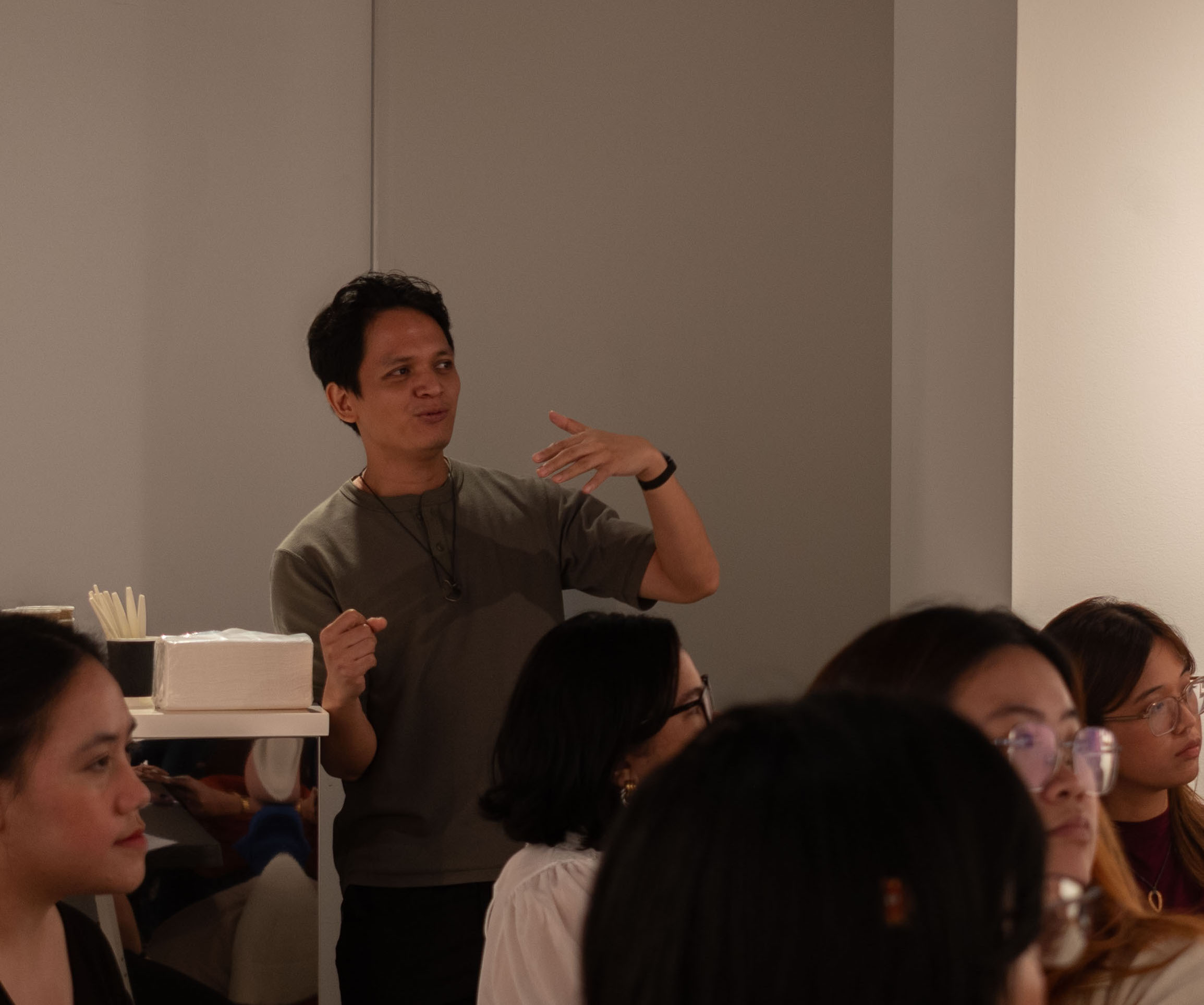
Madlangsakay during the artist talk

Marz Aglipay: For the benefit of those who are not familiar with printmaking, the practice is more like a manual version of printing as opposed to mechanical printing that involves computers.

EMJ: Yes. My process involves both. The images are printed and produced mechanically from videos. This is the process I want to explore especially amid the proliferation of Artificial Intelligence (AI). I think we’ve come to a point where it has become challenging to identify whether an image is generated by AI or made by a human. This process is my way of resistance. 

Audience: Why rubbercut in particular?

Artist: I knew I wanted to do printmaking, but not necessarily rubbercut. It just happened to be the most accessible to me since other techniques require a printing press. It also allows repetition, which as you notice has evolved as a key imagery in my works. 

Audience Member: I’d like to ask about the curatorial side. Did you always have the idea of exhibiting your works behind glass? I like how this curatorial choice added some mischief to the show. It’s a window, but it’s behind glass—exactly the perspective of someone inside a train.

Audience: Is there also a reason behind the sequencing of how your works are displayed? 

EMJ: Not exactly, but I liked the idea of the works moving around the space. For example, “Occurrent” and the first piece in “Never and always too late (to behold)” series are somewhat monochromatic, followed by a sudden explosion of colors. I relate this to the sudden change in environment that you experience in transit. Think of passing through Ayala Station as you ride the MRT. 

Perhaps more significant is the horizontal orientation of the works. With this, I try to replicate the physical and spatial feeling of riding a train.

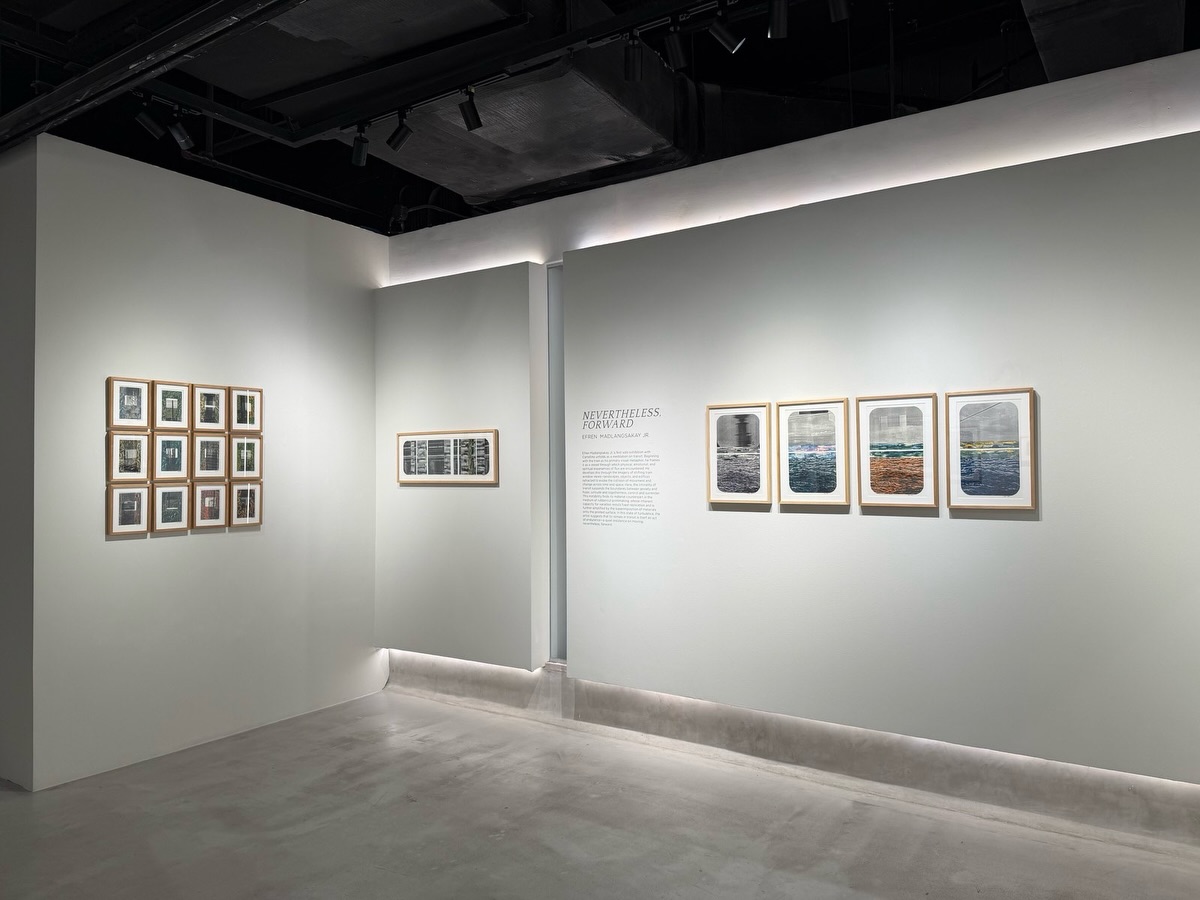
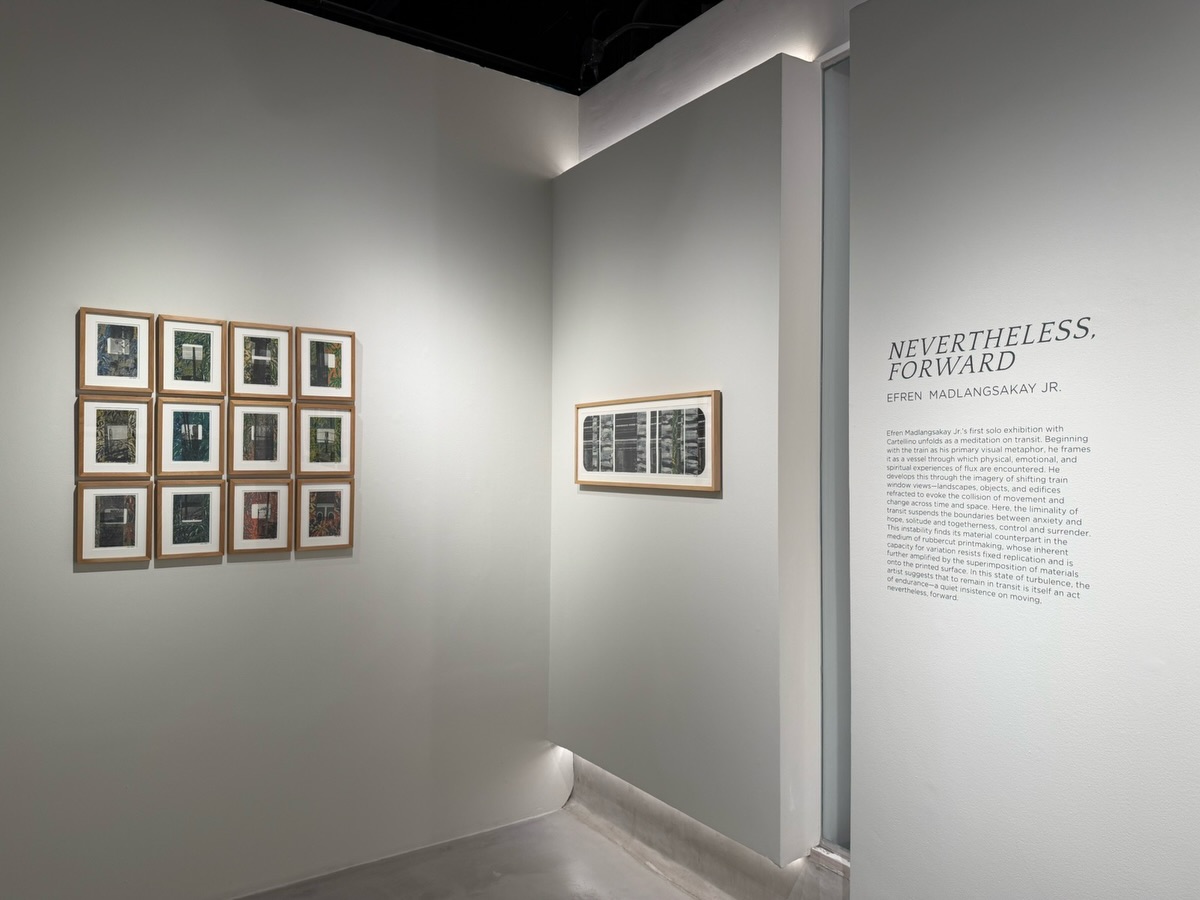
“Nevertheless, forward,” was on view from July 17 to August 16, 2026 at Cartellino

Word for Word is a series of transcriptions of public programs, including artist talks, conversations, and walkthroughs, by Cartellino

Transcription edited for clarity.

[order] => 0 [type] => blog_post [status] => published [created] => 2026-08-31 22:11:10 [modified] => 2026-08-31 22:30:42 [post_date] => 2026-08-31 22:11:00 [category_id] => 0 [parent_id] => 4 [parent_slug] => features [parent_title] => Features [author_id] => 46 [author_name] => THE CARTELLINO TEAM [first_name] => The Cartellino [last_name] => Team [username] => cartellino.art [nickname] => The Cartellino Team [metadata] => a:28:{s:10:"page_title";s:111:"

word For Word: Efren Madlangsakay Jr. On A Worldview Shaped By Continual Movement 

";s:4:"tags";s:0:"";s:10:"source_url";s:0:"";s:7:"excerpt";s:0:"";s:11:"readability";s:0:"";s:14:"social_excerpt";s:0:"";s:5:"quote";s:0:"";s:11:"post_footer";s:0:"";s:13:"featured_post";s:1:"1";s:17:"featured_category";s:0:"";s:15:"featured_slider";s:0:"";s:14:"featured_quote";s:0:"";s:7:"comment";s:1:"1";s:10:"post_image";s:52:"uploads/2026/08/a672560b9d9d81cc16be87234046c039.jpg";s:11:"post_image2";s:52:"uploads/2026/08/3768b8f04d57d14fe75139589913577f.jpg";s:11:"post_image3";s:52:"uploads/2026/08/682ca5929ab862c7a6d2efc9671b1ab5.jpg";s:9:"post_type";s:0:"";s:11:"artist_name";s:0:"";s:13:"duration_from";s:0:"";s:11:"duration_to";s:0:"";s:17:"short_description";s:0:"";s:12:"artist_label";s:16:"About the Artist";s:16:"about_the_artist";s:0:"";s:14:"catalogue_link";s:0:"";s:14:"featured_works";s:0:"";s:11:"author_name";s:19:"THE CARTELLINO TEAM";s:15:"event_date_from";s:19:"2026-08-31 22:30:42";s:13:"event_date_to";s:19:"2026-08-31 22:30:42";} [category_title] => [category_slug] => )

Word for Word: Efren Madlangsakay Jr. on a worldview shaped by continual movement 

How does a life of transit shape one’s worldview and artmaking? On the first session of Art Writing for Evolving Platforms held last July 18, 2026, Efren Madlangsakay Jr. gave a talk on the conceptual, visual, and processual inspirations that influence his practice. Madlangsakay recalls a life spent on transit as key to its unfolding, interlaced with contemporary developments on technology and printmaking.

Read below for a partial transcription of the talk and the corresponding open discussion with the workshop participants.

Efren Madlangsakay Jr.: The exhibition began with hope in the idea that whatever the circumstance you may find yourself in, nevertheless, you move forward. From this, my initial inspiration was being in transit—specifically, inside a moving train. I was curious about how the decision to relinquish all control of our journey may give us both peace and anxiety. There is also the idea of being still inside something that is moving. 

https://www.instagram.com/p/Da485uKFEWx/?img_index=1

Aside from these internal contemplations, much of my inspiration is also derived from the visual experience of riding a train. When you look at my works, you will notice imagery gathered from videos taken while I was inside the vehicle. See, for instance, “Never and always too late (to behold).” There is the impression of a window reflection, as if a glass pane is obstructing one’s view. Then we have the electrical lines and posts with the sky peeking behind them. Being in transit, our appreciation and view of the natural world would always become obstructed by manmade structures. But even then, we find something beautiful from them. 

“Never and always too late (to behold),” series of four

I move on to “A passing prayer,” which shows a view of the Baclaran Church. To give you some background, I was primarily drawn to the concept of transit because of its ubiquity in my personal life. I live in Las Piñas, but I studied in Quezon City. During my commutes, I would frequently pass by the area near Baclaran Church. From this, I took interest in the idea of a church as a station; when we pass by a place of worship during transit, we would make the sign of the cross or touch the rosary hanging on our dashboards. I found it interesting how travelling would provoke these actions. In addition, this piece is a good illustration of my explorations with framing. I would often use the shape of a train window as a frame. I also like to play with orientation; at times, I intentionally leave the orientation askew to capture the notion of movement.

“A passing prayer” featuring views of the Baclaran Church

Also important to my practice are the titles I give my works. Words usually serve as my prompt. In “Embark, alight,” I played with the words’ meanings. “Embark” means to get on, like to start an adventure. Meanwhile, “alight” is more than just getting off a means of transportation; it also evokes being in somewhere new. With this, I go back to my earlier allusion to the contrasting emotions we feel while riding trains. I call this hopeful anxiety or fearful anxiety—muddled feelings within departures, arrivals, and journeys.

This next work is where the title of this exhibition originated. You will notice a sense of fullness from this titular piece, in contrast to the others that are more bounded especially with the shapes of train windows. It gives visual references to overflows across borders, similar to how we persist in moving forward even after reaching full capacity.

“Nevertheless, forward,” the titular work of the exhibition

Audience Member: How do you choose your colors?.

Artist: It’s partly intuitive. I don’t think about the colors at the start. I normally get a feel of what colors I wish to add as I see the work unfold. But I usually tend to be colorful.

Audience: I’m curious about your process. In what particular order do you layer your materials?

EMJ: I think of it like painting with rubbercut prints. Usually, I begin with photo transfer. I then press the rubbercut print onto the paper, then rub the excess paper off so that we are left with ink as residue. However, I try to leave residual pieces of paper since they contribute to the texture. The idea for this process came from test prints. As I worked with the medium, I sought a way to make use of the test prints that were piling up in my collection. Other artists, for example, extract the images from magazines using glue. The ink in printmaking is an offset printer’s ink. This is also what we use in printing magazines. I used this principle to make these works.

Madlangsakay during the artist talk

Marz Aglipay: For the benefit of those who are not familiar with printmaking, the practice is more like a manual version of printing as opposed to mechanical printing that involves computers.

EMJ: Yes. My process involves both. The images are printed and produced mechanically from videos. This is the process I want to explore especially amid the proliferation of Artificial Intelligence (AI). I think we’ve come to a point where it has become challenging to identify whether an image is generated by AI or made by a human. This process is my way of resistance. 

Audience: Why rubbercut in particular?

Artist: I knew I wanted to do printmaking, but not necessarily rubbercut. It just happened to be the most accessible to me since other techniques require a printing press. It also allows repetition, which as you notice has evolved as a key imagery in my works. 

Audience Member: I’d like to ask about the curatorial side. Did you always have the idea of exhibiting your works behind glass? I like how this curatorial choice added some mischief to the show. It’s a window, but it’s behind glass—exactly the perspective of someone inside a train.

Audience: Is there also a reason behind the sequencing of how your works are displayed? 

EMJ: Not exactly, but I liked the idea of the works moving around the space. For example, “Occurrent” and the first piece in “Never and always too late (to behold)” series are somewhat monochromatic, followed by a sudden explosion of colors. I relate this to the sudden change in environment that you experience in transit. Think of passing through Ayala Station as you ride the MRT. 

Perhaps more significant is the horizontal orientation of the works. With this, I try to replicate the physical and spatial feeling of riding a train.

“Nevertheless, forward,” was on view from July 17 to August 16, 2026 at Cartellino

Word for Word is a series of transcriptions of public programs, including artist talks, conversations, and walkthroughs, by Cartellino

Transcription edited for clarity.