
• Jun. 3, 2026
											stdClass Object
(
    [id] => 847
    [title] => 

Binakya: A shoe, the self, a mirror of approximations

[slug] => 2026/06/03/Binakya-A-shoe-the-self-a-mirror-of-approximations [body] =>

This essay is a response to Nash Cruz and Serena San Jose’s show ‘Parang Parang’ at JOS apartment, Makati.

Through reworking JOS mundo’s Parang Bakya heel and wedge using digital (3D scanning, modelling, and printing) and analog fabrication (resin casting, leather & fabric manipulation), ‘Parang Parang’ is an exploration by artist Nash Cruz and designer Serena San Jose into Filipino identity, where cultural memory through replication gestures into something continually becoming.

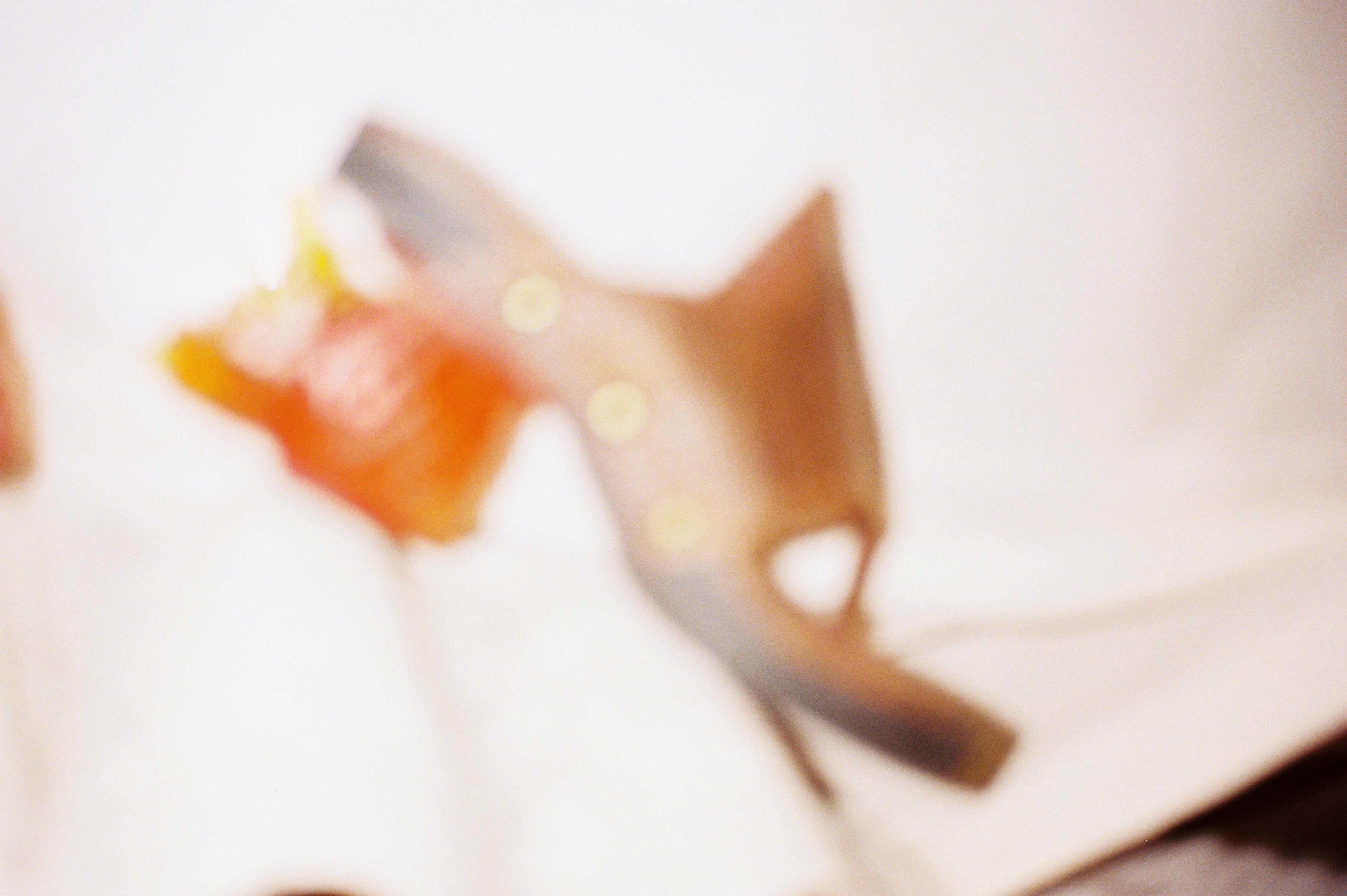
The Parang Bakya reworked by Nash Cruz and Serena San Jose shot on film. Image courtesy of Nash Cruz and JOS mundo.

Identity is a play of light in front of a mirror. Francesca Woodman in long exposure during her halcyon days. In her self-portraits, her body is always poised for revision: lost in plaster or chintz wallpaper, shrouded in lace, or clothed in a polka dot dress. Sometimes, there it is, in a garment. All at once: the entire life cycle of a dream-self. It is the search, the fantasy, the reality. I come to a showroom to be in thrall to its many manifestations, or to find it fully-formed, waiting only to consume its wearer, bearing little to no trace of its production.

To appear fully: that is the fantasy. But fantasy is also specious. The moment you touch its surface, it quivers. All that’s solid melts into air, Marx put it once. 


***


I wrote, I saw myself in a shoe. I know how that sounds. The Critic in me would remark about the silliness of it, its superficiality. How fickle, it would say, how naive. This is capitalism’s intention for me: to believe in the transformative, or representational, power of objects. To see myself in a shoe is to behave as the system wants me to behave. To desire objects is to be complicit in a fashion system of commodified desire that sees bodies as mere “surfaces onto which a visual image or immaterial concept is projected.”1 The body in fashion is something to be decoded as text—abstract, immaterial, a tabula rasa onto which moral judgments are superimposed. (Indigenous, foreign. Modest, vulgar, decent. Intelligent, educated, alluring, attractive, indecent, filthy, lewd). Even when I do not directly participate, I become an onlooker to a never-ending stream of visual experiences. There it is, its grotesque spectacle of runways, lookbooks, campaigns, fitchecks—hallucinatory visuals in the milky glow of a screen. But how many times in the past have I mistaken a modern iteration of a buri bag or a thrifted sweater with a glittery Paris brand label on it to announce my Filipino-ness, my woman-ness, to approximate the version of Filipino Woman I had in my head?

I found that a skirt in history did the same. The saya, as we know it, was worn by all kinds of women in the 1840s. It took many forms and announced one’s station: the cut, the cloth, the length. Once the seven-panelled pares held together by head pins, narrow and close-fitting, it became the saya a la mascota, looser and semi-billowy, made from checkered cotton, working-class in its practicality. When more sophisticated looms were introduced, it became the saya de cola, a saya with bigger and fewer textile panels, from which a train or cola could be created. It was how the rich declared their rank. The skirt became part of the “correct” ensemble worn during fiestas, intimate evening soirées, and churchgoing. It was called la paloma or “the dove’s tail” when it had a shorter train, and media cola if it had a longer one. Stephanie Coo in Clothing and the Colonial Culture of Appearances in Nineteenth-Century Spanish Philippines (1820–1896) writes, “The train in her saya provides clues to her social itinerary.”² The longer the train, the more special the occasion. 

Fashion, ever so capricious with its swift disenchantments and variations of the same, is also a system that confirms status, enforces hierarchies, and represents social divisions. A privileged young woman, at the time, wore a saya de cola to be photographed and captured in time. During afternoon promenades at the Paseo de Luneta, she wore it with no stockings underneath. Her saya was made from the finest silk and satin, in varied floral, striped, and celestial patterns, while the working-class women, the buyeras, lecheras, panaderas, lavanderas, among others, wore theirs in checkered cotton imported from Madras, India, with no petticoats underneath, no flowing trains. Instead, their sayas skimmed the calf, a portion of skin exposed, as they balanced over their heads jars of water and baskets of vegetables. Completing that humble ensemble, they wore bakyas during rainy days when the streets were muddy and slippery, the heels rising one to two inches from the earth. 


***


I am reluctant to say more about the “I.” A part of me believes that I am still writing criticism—the predominant mode, that is. I am trying to abandon the “male” mode of rhetoric. It requires me to present you with a prefatory litany of critical sources in order to make sense, to unpack, to comprehend, to analyze, to think through. What would it be like, then, to obfuscate the boundary between the writing self and the subject that one is compelled to write about?

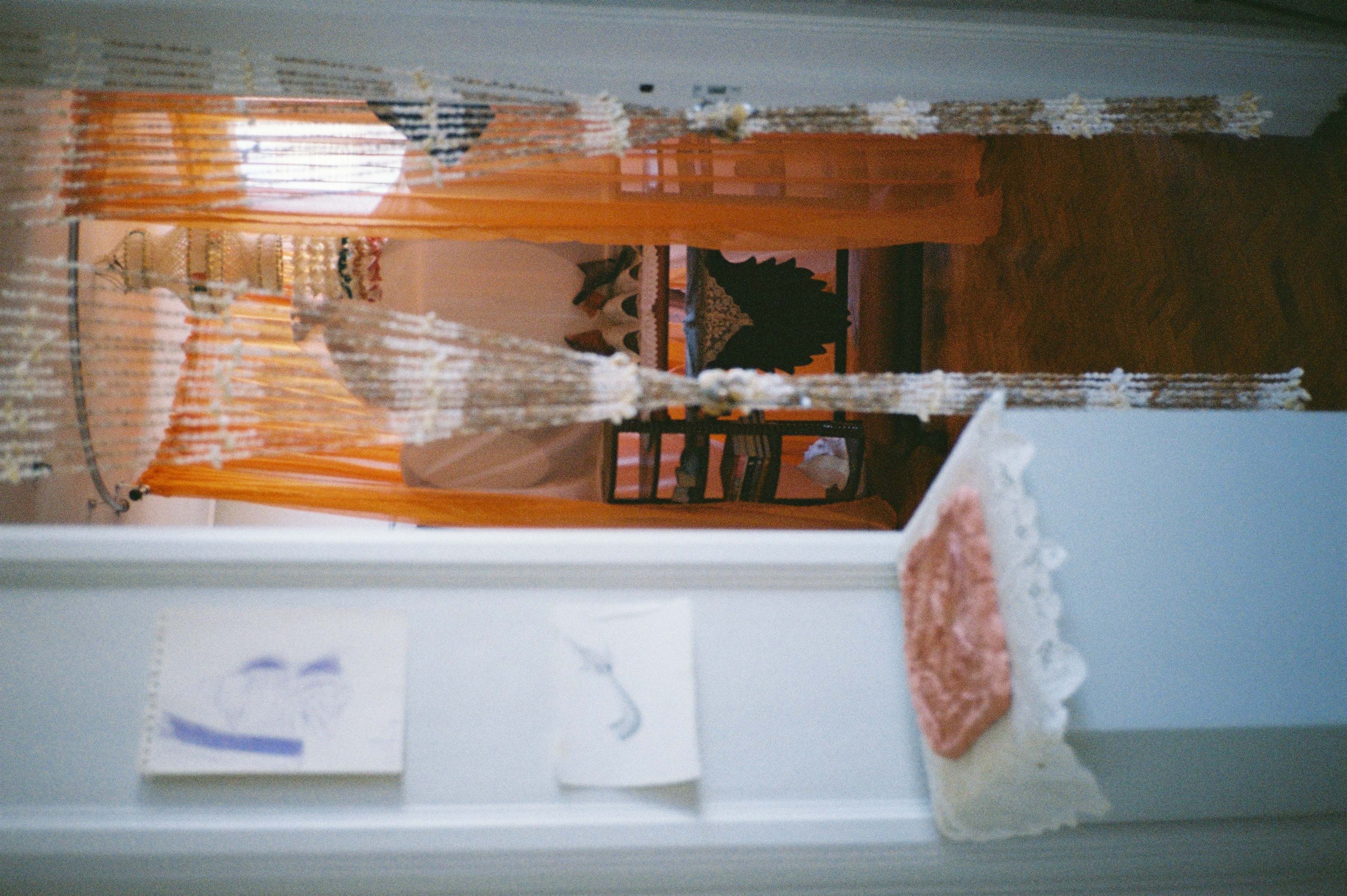
Installation view of Parang Parang at the JOS mundo showroom shot on film. Image courtesy of Nash Cruz and JOS mundo.

I want to write an image instead. An image of an aparador in a room, the most Filipino of furniture forms. It is artist Cian Dayrit’s aparador titled Tiis Ganda Kutis Amerikana (Sacrifice for Beauty, American Complexion). I am in the JOS showroom, in the penthouse at 30 Polaris in Poblacion. The aparador has three mirrors. Gauzy white curtains, reminiscent of mosquito netting, deter my reflection. It almost gives off this quality of a haunting, perhaps, because it reminds me of a Jewish tradition during shiva dating back centuries, when mirrors are shrouded with cloth in periods of mourning so the bereaved come to a state of inwardness and reflection. I step inside. I take a photo of myself, but I am not legible. Only my shadow, its outer edges, is evident. I am an indeterminate form, an exterior image of myself, but I do not feel perturbed by this body-losing-form, flitting in the clement light. Instead, it feels like relief—from what? This burden of perpetual self-definition, ‘the heroism of description’—pure and rich as cream. 

Upon the shelf, resting on a white, fluted clam shell, sit two aged, dark wooden platform sandals. They resemble footwear that might once have been called bakya, the humble wooden clog of the working-class vendedora in the 1840s. But these are the Parang Bakya sandals by JOS. The Parang Bakya, meaning “like a bakya” or “resembling a bakya.Parang—a preposition heavy with meaning, almost phenomenological. The bakya itself is a sign; it represents something—a memory, a general impression, a scene, the shape of character—constituted in the body as dress. As such, a clothed body is laden with meaning; our particular ways of dressing have a social and moral imperative to them. In the case of Philippine colonial history, the bakya was the working-class shoe in the 19th century, and became a shibboleth to signal a certain style and sensibility in the middle of the 20th century. The writer Jose F. Lacaba traces the genealogy of the term bakya all the way back to the movies. It was said to have been coined in the 1950s when acclaimed director Lamberto V. Avellana referred to the spate of bakya-wearing wives or young women who came clacking into the cinemas to watch low-budget movies churned out for easy mass consumption. It had come to mean anything “cheap, gauche, naive, provincial, and terribly popular.”³ Decades later, the bakya has been re-inscribed in the name of nationalism to symbolize “the Filipino’s humble beginnings.”

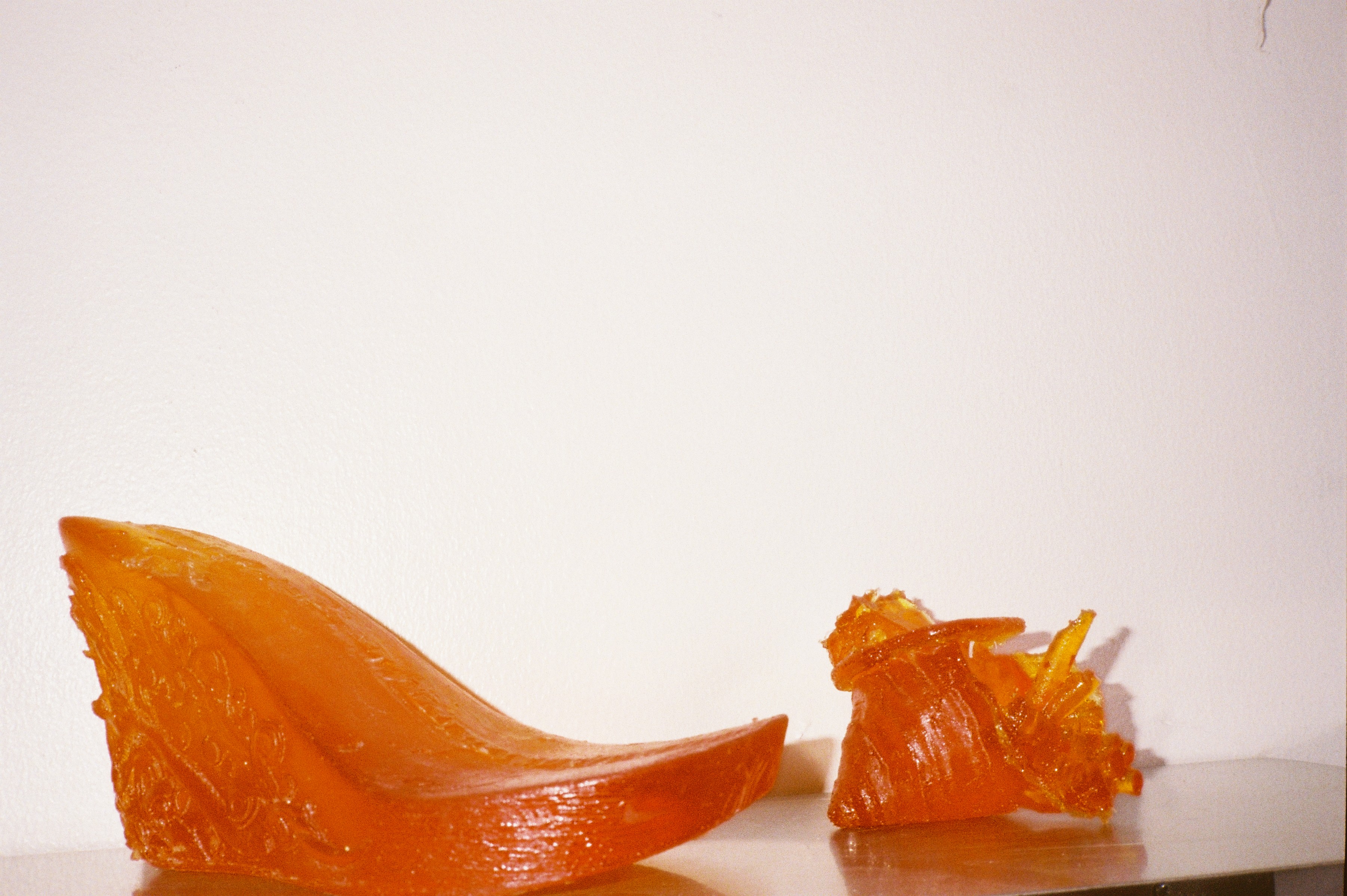
The Parang Bakya Replica by Nash Cruz shot on film. Image courtesy of Nash Cruz and JOS mundo.

The Parang Bakya itself is an approximation of the original word. It enters at a remove, precisely because so much has happened in history. And yet, it almost feels like it refuses to carry the entirety of that history, at the same time that it refuses to become another symbol. There is something there, I think, something honest. I read it as this refusal to be conscripted.

On Cian’s aparador are more of these subversive approximations by artist Nash Cruz. Move closer, and you will see that the once wooden heels of the Parang Bakya are amber-lacquered, catching the light like bronze varnish, but more translucent now, hollow. One of the heels is an ashtray heel. Where you would expect a landscape motif, or a bahay-kubo, you get cigarette butts jutting out of the heel shaped like a conch shell, a mermaid’s tail shaped like the Nike swoosh. It is unapologetically self-referential, a little tongue-in-cheek. The shell, a symbol laden with its own meaning and associations, becomes, simply, an ashtray. The inverse is also true: an object of commonplace ritual, when adorned, becomes something else: a marker of sensuality or devotion or identity. The shoe’s upper and footbed, previously made of deadstock leather, fish skin, or suede, have been replaced, too. Now it’s become something mottled, palimpsestic. The material here is a result of designer Serena San Jose’s experimentations with Kombucha’s fermentation process. A pellicle forms on top of the brew, which then becomes the SCOBY used in the shoe. She harvests this and then processes it into leather. The material introduces something alive, impermanent, bodily. 

All these transformations also seem to be refusals of a certain kind—the refusal of what is original, pure, or rarified. The fashion historian Anne Hollander once said that, “The idea that fashion simply signals the perpetual flouting of tradition is insufficient: rather, it makes use of tradition and flouts the idea of tradition at the same time, creating a much more complicated kind of subversive element in visual life.”⁴ It reminds me of what parang can signify as a word: as something that seems like, but is not quite like, a mere replica of an original. But it is also something quite deeper: a sense of parang-ness. A deliberate disavowal. The espousing of one’s own difference and of the gap that cannot be bridged. A subversive kind of unknowability that lets one revel in one’s own state of parang-ness. A parang that is not reaching for something, or perpetually striving to arrive, but an approximation that exists in its own right—that has perfected its own distortions, convolutions, slippages and illusions. 


***


If there was one place I used to go to dream as a young woman, it was in one of those rooms. Or a version of it. Sometimes it was a showroom with a silver-grey silk dress in it with the entreaties of a flattering mirror, but more often just the stark, blank page. The way I write—have written—is, after all, a kind of self-fashioning. The novelist and literary critic Elizabeth Hardwick once said that “description and landscape are like layers of underclothes.” The novel or the essay or the poem, and the language in which they are written, then, become the dress. In many ways, the writing I have done has epitomized a kind of autobiography. The blank page was a mirror, which I had held a half-hearted faith would reflect the objective truth. I wrote to draw the edges of who I was at the time of writing, a timestamp of diaristic intent, knowing that when I was done, I would have finished that season or cycle of my life and was already fashioning a new one. 

Since then, I have slanted more towards the notion of the autobiographical—that my essays, too, have always been an armoire for the caprice of my imagination, that is, for a kind of autofabulation. A parang in writing. Sometimes I want to write essays that daydream, that swing their legs and twist their hair, that draw closer to the source material as nimbly as they flee, as though they were young, sprightly girls caught in a kind of literary cat-and-mouse. On most days, though, I want them to dither and digress, to bite their own tongues and temper their passions as a sensible, aged woman would, gracefully, in a pensive accounting of her love-felled youth already lived and lost. I write and continue to wrought a sense of self from them, the way all writers do, the way they always have. 

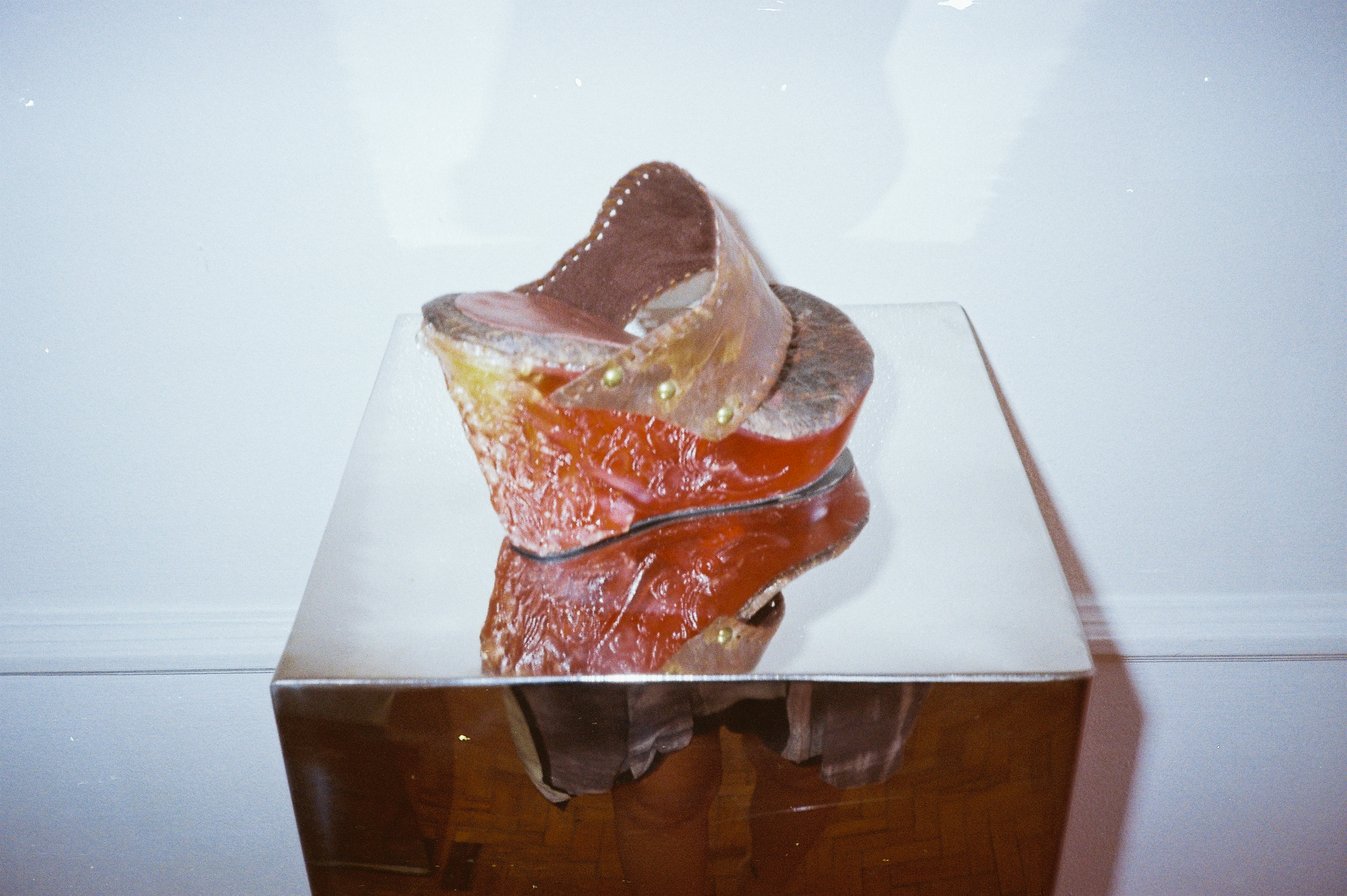
The Parang Bakya reworked by Nash Cruz and Serena San Jose shot on film. Image courtesy of Nash Cruz and JOS mundo.

Who is the Filipina writer?  I have not come close to easy answers, and maybe there aren't any. I have merely rendered half-convincing, intricately dressed approximations. As a Philippine Anglophone writer, it ironically feels like being dressed by someone else, or standing in front of the mirror and realizing that the grey-silk dress—no matter how striking— is, after all, an ill-fitting one. Abandon English then, they say, return to your mother tongue. One reaches an impasse. How should one begin, continue?

In literature, as in fashion, the word and the garment are considered metonymic of the wearer-writer, as though to name one thing is to allude to or evoke the presence of another. But Bill Ashcroft posits that in post-colonial literature, a gap exists, one he calls a metonymic gap. This gap exists when a post-colonial writer writing in English “transforms” the text by purposefully contaminating it with “unglossed words, phrases, or passages from a first language; by using concepts, allusions, or references that may be unknown to the reader; by syntactic fusion; by code-switching; by transforming literary language with vernacular syntax or rhythms; or even by generating a particular cultural music in their prosody.” These textual gestures, Ashcroft posits, exemplify the post-colonial writer’s “very resistance to interpretation” by signaling and emphasizing difference through the use of the colonizer’s language.

How does this ‘gap’ play out in the language of clothes? Coo in her study points to a particular quality of fashion that is relentless in its arrogations, constantly subverting and destabilizing fixed and inherited forms or modes of dress. There were, to borrow writing’s parlance, revisions. The Filipino baro, she observes, took its folded collar and long-cuffed sleeves from European tailoring, yet was acclimatised in nipis and worn consistently untucked. The Filipina woman, taken to dancing, wore the traje del país with its airy, wide sleeves, flouting the corset European women had to wear during social gatherings. In the sweltering summer of the tropics, the Filipina was, as Coo writes, “more free, or at least, appeared more free.”⁷

It is here that I find a path forward, or a clearing through which I ad(dress) the question itself, the question of who the Filipina writer is. A line by Clarice Lispector comes to mind: “dressing up was a ritual that put her in a serious mood: the cloth was no longer a mere fabric, it was becoming the matter of the thing and it was this material to which with her body she gave body—”⁸ It was this material to which with her body she gave body

So I do not abandon the grey-silk dress. Not completely. My body gives it body, the way that, perhaps, my own rendering of English gives the text its own. “Only then did she dress herself in herself, she spent the rest of her day obediently playing the role of being,”⁹ Clarice said again. I slip into this grey-silk dress, but it is not a tabula rasa, because I can almost just see the hands that embroidered the capiz shells in the halter neckline and along the bodice until the shape resembles a precious stone. With it, I go out for a night in the city, raised slightly off the ground, rehearsing my own gait, in wooden heels. 

Works cited

  1. Bruggeman, Daniëlle. Dissolving the Ego of Fashion: Engaging with Human Matters. ArtEZ Press, 2018, p. 7.
  2. Coo, Stéphanie Marie R. Clothing and the Colonial Culture of Appearances in Nineteenth-Century Spanish Philippines (1820–1896). 2014. Université Nice Sophia Antipolis, PhD dissertation. HAL Theses, theses.hal.science/tel-01126974, p. 149.
  3. Lacaba, Jose F. “Notes on ‘Bakya’: Being an Apology, of Sorts, for Filipino Masscult.” Days of Disquiet, Nights of Rage: The First Quarter Storm and Related Events, Anvil Publishing, 2003.
  4. Hollander, Anne. “Without Looking.” London Review of Books, vol. 17, no. 15, 10 Aug. 1995, www.lrb.co.uk/the-paper/v17/n15/anne-hollander/without-looking.
  5. Hardwick, Elizabeth. “Writing a Novel.” The New York Review of Books, 18 Oct. 1973, www.nybooks.com/articles/1973/10/18/writing-a-novel/.
  6. Ashcroft, Bill. "Bridging the Silence: Inner Translation and the Metonymic Gap." Language and Translation in Postcolonial Literatures: Multilingual Contexts, Translational Texts, edited by Simona Bertacco, Routledge, 2014, p. 56.
  7. Coo, Stéphanie Marie R. Clothing and the Colonial Culture of Appearances in Nineteenth-Century Spanish Philippines (1820–1896). 2014. Université Nice Sophia Antipolis, PhD dissertation. HAL Theses, theses.hal.science/tel-01126974, p. 116. 
  8. Lispector, Clarice. An Apprenticeship, or The Book of Pleasures. Translated by Stefan Tobler, New Directions, 2021, p. 6. 
  9. Lispector, Clarice. The Hour of the Star. Translated by Benjamin Moser, New Directions, 2011, p. 44.

Parang Parang ran from May 5 - May 31, 2026 at the Jos mundo Showroom, Makati City.

Zea Asis is the author of Strange Intimacies (2023), a collection of essays. 

[order] => 0 [type] => blog_post [status] => published [created] => 2026-06-01 15:40:26 [modified] => 2026-06-03 19:28:17 [post_date] => 2026-06-03 18:40:00 [category_id] => 0 [parent_id] => 4 [parent_slug] => features [parent_title] => Features [author_id] => 46 [author_name] => ZEA ASIS [first_name] => The Cartellino [last_name] => Team [username] => cartellino.art [nickname] => The Cartellino Team [metadata] => a:28:{s:10:"page_title";s:77:"

binakya: A Shoe, The Self, A Mirror Of Approximations

";s:4:"tags";s:0:"";s:10:"source_url";s:0:"";s:7:"excerpt";s:0:"";s:11:"readability";s:0:"";s:14:"social_excerpt";s:0:"";s:5:"quote";s:0:"";s:11:"post_footer";s:0:"";s:13:"featured_post";s:1:"1";s:17:"featured_category";s:0:"";s:15:"featured_slider";s:0:"";s:14:"featured_quote";s:0:"";s:7:"comment";s:1:"1";s:10:"post_image";s:52:"uploads/2026/06/d8bcf18868c032690069b6765696d220.JPG";s:11:"post_image2";s:52:"uploads/2026/06/ce20b5cf5ec3a6b088a4fb612c5f45bd.JPG";s:11:"post_image3";s:52:"uploads/2026/06/202f07689333ba0244e7058e8ef902a4.jpg";s:9:"post_type";s:0:"";s:11:"artist_name";s:0:"";s:13:"duration_from";s:0:"";s:11:"duration_to";s:0:"";s:17:"short_description";s:0:"";s:12:"artist_label";s:16:"About the Artist";s:16:"about_the_artist";s:0:"";s:14:"catalogue_link";s:0:"";s:14:"featured_works";s:0:"";s:11:"author_name";s:8:"ZEA ASIS";s:15:"event_date_from";s:19:"2026-06-03 19:28:17";s:13:"event_date_to";s:19:"2026-06-03 19:28:17";} [category_title] => [category_slug] => )

Binakya: A shoe, the self, a mirror of approximations

This essay is a response to Nash Cruz and Serena San Jose’s show ‘Parang Parang’ at JOS apartment, Makati.

Through reworking JOS mundo’s Parang Bakya heel and wedge using digital (3D scanning, modelling, and printing) and analog fabrication (resin casting, leather & fabric manipulation), ‘Parang Parang’ is an exploration by artist Nash Cruz and designer Serena San Jose into Filipino identity, where cultural memory through replication gestures into something continually becoming.

The Parang Bakya reworked by Nash Cruz and Serena San Jose shot on film. Image courtesy of Nash Cruz and JOS mundo.

Identity is a play of light in front of a mirror. Francesca Woodman in long exposure during her halcyon days. In her self-portraits, her body is always poised for revision: lost in plaster or chintz wallpaper, shrouded in lace, or clothed in a polka dot dress. Sometimes, there it is, in a garment. All at once: the entire life cycle of a dream-self. It is the search, the fantasy, the reality. I come to a showroom to be in thrall to its many manifestations, or to find it fully-formed, waiting only to consume its wearer, bearing little to no trace of its production.

To appear fully: that is the fantasy. But fantasy is also specious. The moment you touch its surface, it quivers. All that’s solid melts into air, Marx put it once. 


***


I wrote, I saw myself in a shoe. I know how that sounds. The Critic in me would remark about the silliness of it, its superficiality. How fickle, it would say, how naive. This is capitalism’s intention for me: to believe in the transformative, or representational, power of objects. To see myself in a shoe is to behave as the system wants me to behave. To desire objects is to be complicit in a fashion system of commodified desire that sees bodies as mere “surfaces onto which a visual image or immaterial concept is projected.”1 The body in fashion is something to be decoded as text—abstract, immaterial, a tabula rasa onto which moral judgments are superimposed. (Indigenous, foreign. Modest, vulgar, decent. Intelligent, educated, alluring, attractive, indecent, filthy, lewd). Even when I do not directly participate, I become an onlooker to a never-ending stream of visual experiences. There it is, its grotesque spectacle of runways, lookbooks, campaigns, fitchecks—hallucinatory visuals in the milky glow of a screen. But how many times in the past have I mistaken a modern iteration of a buri bag or a thrifted sweater with a glittery Paris brand label on it to announce my Filipino-ness, my woman-ness, to approximate the version of Filipino Woman I had in my head?

I found that a skirt in history did the same. The saya, as we know it, was worn by all kinds of women in the 1840s. It took many forms and announced one’s station: the cut, the cloth, the length. Once the seven-panelled pares held together by head pins, narrow and close-fitting, it became the saya a la mascota, looser and semi-billowy, made from checkered cotton, working-class in its practicality. When more sophisticated looms were introduced, it became the saya de cola, a saya with bigger and fewer textile panels, from which a train or cola could be created. It was how the rich declared their rank. The skirt became part of the “correct” ensemble worn during fiestas, intimate evening soirées, and churchgoing. It was called la paloma or “the dove’s tail” when it had a shorter train, and media cola if it had a longer one. Stephanie Coo in Clothing and the Colonial Culture of Appearances in Nineteenth-Century Spanish Philippines (1820–1896) writes, “The train in her saya provides clues to her social itinerary.”² The longer the train, the more special the occasion. 

Fashion, ever so capricious with its swift disenchantments and variations of the same, is also a system that confirms status, enforces hierarchies, and represents social divisions. A privileged young woman, at the time, wore a saya de cola to be photographed and captured in time. During afternoon promenades at the Paseo de Luneta, she wore it with no stockings underneath. Her saya was made from the finest silk and satin, in varied floral, striped, and celestial patterns, while the working-class women, the buyeras, lecheras, panaderas, lavanderas, among others, wore theirs in checkered cotton imported from Madras, India, with no petticoats underneath, no flowing trains. Instead, their sayas skimmed the calf, a portion of skin exposed, as they balanced over their heads jars of water and baskets of vegetables. Completing that humble ensemble, they wore bakyas during rainy days when the streets were muddy and slippery, the heels rising one to two inches from the earth. 


***


I am reluctant to say more about the “I.” A part of me believes that I am still writing criticism—the predominant mode, that is. I am trying to abandon the “male” mode of rhetoric. It requires me to present you with a prefatory litany of critical sources in order to make sense, to unpack, to comprehend, to analyze, to think through. What would it be like, then, to obfuscate the boundary between the writing self and the subject that one is compelled to write about?

Installation view of Parang Parang at the JOS mundo showroom shot on film. Image courtesy of Nash Cruz and JOS mundo.

I want to write an image instead. An image of an aparador in a room, the most Filipino of furniture forms. It is artist Cian Dayrit’s aparador titled Tiis Ganda Kutis Amerikana (Sacrifice for Beauty, American Complexion). I am in the JOS showroom, in the penthouse at 30 Polaris in Poblacion. The aparador has three mirrors. Gauzy white curtains, reminiscent of mosquito netting, deter my reflection. It almost gives off this quality of a haunting, perhaps, because it reminds me of a Jewish tradition during shiva dating back centuries, when mirrors are shrouded with cloth in periods of mourning so the bereaved come to a state of inwardness and reflection. I step inside. I take a photo of myself, but I am not legible. Only my shadow, its outer edges, is evident. I am an indeterminate form, an exterior image of myself, but I do not feel perturbed by this body-losing-form, flitting in the clement light. Instead, it feels like relief—from what? This burden of perpetual self-definition, ‘the heroism of description’—pure and rich as cream. 

Upon the shelf, resting on a white, fluted clam shell, sit two aged, dark wooden platform sandals. They resemble footwear that might once have been called bakya, the humble wooden clog of the working-class vendedora in the 1840s. But these are the Parang Bakya sandals by JOS. The Parang Bakya, meaning “like a bakya” or “resembling a bakya.Parang—a preposition heavy with meaning, almost phenomenological. The bakya itself is a sign; it represents something—a memory, a general impression, a scene, the shape of character—constituted in the body as dress. As such, a clothed body is laden with meaning; our particular ways of dressing have a social and moral imperative to them. In the case of Philippine colonial history, the bakya was the working-class shoe in the 19th century, and became a shibboleth to signal a certain style and sensibility in the middle of the 20th century. The writer Jose F. Lacaba traces the genealogy of the term bakya all the way back to the movies. It was said to have been coined in the 1950s when acclaimed director Lamberto V. Avellana referred to the spate of bakya-wearing wives or young women who came clacking into the cinemas to watch low-budget movies churned out for easy mass consumption. It had come to mean anything “cheap, gauche, naive, provincial, and terribly popular.”³ Decades later, the bakya has been re-inscribed in the name of nationalism to symbolize “the Filipino’s humble beginnings.”

The Parang Bakya Replica by Nash Cruz shot on film. Image courtesy of Nash Cruz and JOS mundo.

The Parang Bakya itself is an approximation of the original word. It enters at a remove, precisely because so much has happened in history. And yet, it almost feels like it refuses to carry the entirety of that history, at the same time that it refuses to become another symbol. There is something there, I think, something honest. I read it as this refusal to be conscripted.

On Cian’s aparador are more of these subversive approximations by artist Nash Cruz. Move closer, and you will see that the once wooden heels of the Parang Bakya are amber-lacquered, catching the light like bronze varnish, but more translucent now, hollow. One of the heels is an ashtray heel. Where you would expect a landscape motif, or a bahay-kubo, you get cigarette butts jutting out of the heel shaped like a conch shell, a mermaid’s tail shaped like the Nike swoosh. It is unapologetically self-referential, a little tongue-in-cheek. The shell, a symbol laden with its own meaning and associations, becomes, simply, an ashtray. The inverse is also true: an object of commonplace ritual, when adorned, becomes something else: a marker of sensuality or devotion or identity. The shoe’s upper and footbed, previously made of deadstock leather, fish skin, or suede, have been replaced, too. Now it’s become something mottled, palimpsestic. The material here is a result of designer Serena San Jose’s experimentations with Kombucha’s fermentation process. A pellicle forms on top of the brew, which then becomes the SCOBY used in the shoe. She harvests this and then processes it into leather. The material introduces something alive, impermanent, bodily. 

All these transformations also seem to be refusals of a certain kind—the refusal of what is original, pure, or rarified. The fashion historian Anne Hollander once said that, “The idea that fashion simply signals the perpetual flouting of tradition is insufficient: rather, it makes use of tradition and flouts the idea of tradition at the same time, creating a much more complicated kind of subversive element in visual life.”⁴ It reminds me of what parang can signify as a word: as something that seems like, but is not quite like, a mere replica of an original. But it is also something quite deeper: a sense of parang-ness. A deliberate disavowal. The espousing of one’s own difference and of the gap that cannot be bridged. A subversive kind of unknowability that lets one revel in one’s own state of parang-ness. A parang that is not reaching for something, or perpetually striving to arrive, but an approximation that exists in its own right—that has perfected its own distortions, convolutions, slippages and illusions. 


***


If there was one place I used to go to dream as a young woman, it was in one of those rooms. Or a version of it. Sometimes it was a showroom with a silver-grey silk dress in it with the entreaties of a flattering mirror, but more often just the stark, blank page. The way I write—have written—is, after all, a kind of self-fashioning. The novelist and literary critic Elizabeth Hardwick once said that “description and landscape are like layers of underclothes.” The novel or the essay or the poem, and the language in which they are written, then, become the dress. In many ways, the writing I have done has epitomized a kind of autobiography. The blank page was a mirror, which I had held a half-hearted faith would reflect the objective truth. I wrote to draw the edges of who I was at the time of writing, a timestamp of diaristic intent, knowing that when I was done, I would have finished that season or cycle of my life and was already fashioning a new one. 

Since then, I have slanted more towards the notion of the autobiographical—that my essays, too, have always been an armoire for the caprice of my imagination, that is, for a kind of autofabulation. A parang in writing. Sometimes I want to write essays that daydream, that swing their legs and twist their hair, that draw closer to the source material as nimbly as they flee, as though they were young, sprightly girls caught in a kind of literary cat-and-mouse. On most days, though, I want them to dither and digress, to bite their own tongues and temper their passions as a sensible, aged woman would, gracefully, in a pensive accounting of her love-felled youth already lived and lost. I write and continue to wrought a sense of self from them, the way all writers do, the way they always have. 

The Parang Bakya reworked by Nash Cruz and Serena San Jose shot on film. Image courtesy of Nash Cruz and JOS mundo.

Who is the Filipina writer?  I have not come close to easy answers, and maybe there aren't any. I have merely rendered half-convincing, intricately dressed approximations. As a Philippine Anglophone writer, it ironically feels like being dressed by someone else, or standing in front of the mirror and realizing that the grey-silk dress—no matter how striking— is, after all, an ill-fitting one. Abandon English then, they say, return to your mother tongue. One reaches an impasse. How should one begin, continue?

In literature, as in fashion, the word and the garment are considered metonymic of the wearer-writer, as though to name one thing is to allude to or evoke the presence of another. But Bill Ashcroft posits that in post-colonial literature, a gap exists, one he calls a metonymic gap. This gap exists when a post-colonial writer writing in English “transforms” the text by purposefully contaminating it with “unglossed words, phrases, or passages from a first language; by using concepts, allusions, or references that may be unknown to the reader; by syntactic fusion; by code-switching; by transforming literary language with vernacular syntax or rhythms; or even by generating a particular cultural music in their prosody.” These textual gestures, Ashcroft posits, exemplify the post-colonial writer’s “very resistance to interpretation” by signaling and emphasizing difference through the use of the colonizer’s language.

How does this ‘gap’ play out in the language of clothes? Coo in her study points to a particular quality of fashion that is relentless in its arrogations, constantly subverting and destabilizing fixed and inherited forms or modes of dress. There were, to borrow writing’s parlance, revisions. The Filipino baro, she observes, took its folded collar and long-cuffed sleeves from European tailoring, yet was acclimatised in nipis and worn consistently untucked. The Filipina woman, taken to dancing, wore the traje del país with its airy, wide sleeves, flouting the corset European women had to wear during social gatherings. In the sweltering summer of the tropics, the Filipina was, as Coo writes, “more free, or at least, appeared more free.”⁷

It is here that I find a path forward, or a clearing through which I ad(dress) the question itself, the question of who the Filipina writer is. A line by Clarice Lispector comes to mind: “dressing up was a ritual that put her in a serious mood: the cloth was no longer a mere fabric, it was becoming the matter of the thing and it was this material to which with her body she gave body—”⁸ It was this material to which with her body she gave body

So I do not abandon the grey-silk dress. Not completely. My body gives it body, the way that, perhaps, my own rendering of English gives the text its own. “Only then did she dress herself in herself, she spent the rest of her day obediently playing the role of being,”⁹ Clarice said again. I slip into this grey-silk dress, but it is not a tabula rasa, because I can almost just see the hands that embroidered the capiz shells in the halter neckline and along the bodice until the shape resembles a precious stone. With it, I go out for a night in the city, raised slightly off the ground, rehearsing my own gait, in wooden heels. 

Works cited

  1. Bruggeman, Daniëlle. Dissolving the Ego of Fashion: Engaging with Human Matters. ArtEZ Press, 2018, p. 7.
  2. Coo, Stéphanie Marie R. Clothing and the Colonial Culture of Appearances in Nineteenth-Century Spanish Philippines (1820–1896). 2014. Université Nice Sophia Antipolis, PhD dissertation. HAL Theses, theses.hal.science/tel-01126974, p. 149.
  3. Lacaba, Jose F. “Notes on ‘Bakya’: Being an Apology, of Sorts, for Filipino Masscult.” Days of Disquiet, Nights of Rage: The First Quarter Storm and Related Events, Anvil Publishing, 2003.
  4. Hollander, Anne. “Without Looking.” London Review of Books, vol. 17, no. 15, 10 Aug. 1995, www.lrb.co.uk/the-paper/v17/n15/anne-hollander/without-looking.
  5. Hardwick, Elizabeth. “Writing a Novel.” The New York Review of Books, 18 Oct. 1973, www.nybooks.com/articles/1973/10/18/writing-a-novel/.
  6. Ashcroft, Bill. "Bridging the Silence: Inner Translation and the Metonymic Gap." Language and Translation in Postcolonial Literatures: Multilingual Contexts, Translational Texts, edited by Simona Bertacco, Routledge, 2014, p. 56.
  7. Coo, Stéphanie Marie R. Clothing and the Colonial Culture of Appearances in Nineteenth-Century Spanish Philippines (1820–1896). 2014. Université Nice Sophia Antipolis, PhD dissertation. HAL Theses, theses.hal.science/tel-01126974, p. 116. 
  8. Lispector, Clarice. An Apprenticeship, or The Book of Pleasures. Translated by Stefan Tobler, New Directions, 2021, p. 6. 
  9. Lispector, Clarice. The Hour of the Star. Translated by Benjamin Moser, New Directions, 2011, p. 44.

Parang Parang ran from May 5 - May 31, 2026 at the Jos mundo Showroom, Makati City.

Zea Asis is the author of Strange Intimacies (2023), a collection of essays.