
• Apr. 8, 2026
											stdClass Object
(
    [id] => 844
    [title] => 

This sky is plenty: Digesting Flint’s photo slideshow There is another sky

[slug] => 2026/04/08/This-sky-is-plenty-Digesting-Flints-photo-slideshow-There-is-another-sky [body] =>

“And then there are also times that I'd rather not take the shot.”1

Cycling a cumulative 1,900 kilometers in Siargao, Bohol, Cavite, and Subic in a single Audax season, Gabby Jimenez pushes both mind and body to the limit. Occasionally stopping to rest, refuel, and take stock of what could be considered the extreme extent of a ‘photo walk’, she savors the landscape for its sheer visual pleasure, and just once in a while, does not take the shot.

Jimenez’s Pulse and Pause is one of the nine photography slideshows in There is another sky programmed by the Manila-based photo collective Flint. Curated in 2024 by Flint co-founder Christine Chung, the slideshows are the answers of nine women photographers to Christine’s question-prompt: “What does it mean to remain whole in a world that feels fractured? In the midst of chaos and disarray, where—or how—do you find your anchor?” Sparked by her experience of the intense yet commonplace trauma dealt by circumstances of capitalism, globalization, and migration, Chung curated a diverse cast of fellow photographers whom she admired, and whose answers could assuage her own doubts. This included University of the Philippines fine arts professor Sandra Dans, editorial photographer Cru Camara, musician and music event organizer Ish Santillan, freelance photographer, poet, and writer Arabella Paner, New York-based content strategist and occasional viral storyteller Tammy David, Australia-based photo poet Aia Solis, Canada-based multimedia artist Leah De Leon, graphic designer and cyclist Gabby Jimenez, and award-winning photojournalist Geela Garcia.

Etic-ette: an observer’s thoughts on the thing

In seeking to extend the lifespan of There is another sky and seek new avenues of engagement for its programming, I was brought on by Flint co-founder James Lontoc as moderator, writer, and overall outsider after its first screening at Fotobaryo in 2024. Five private Google Meet calls and a second screening at Cartellino later, I round up my observations.

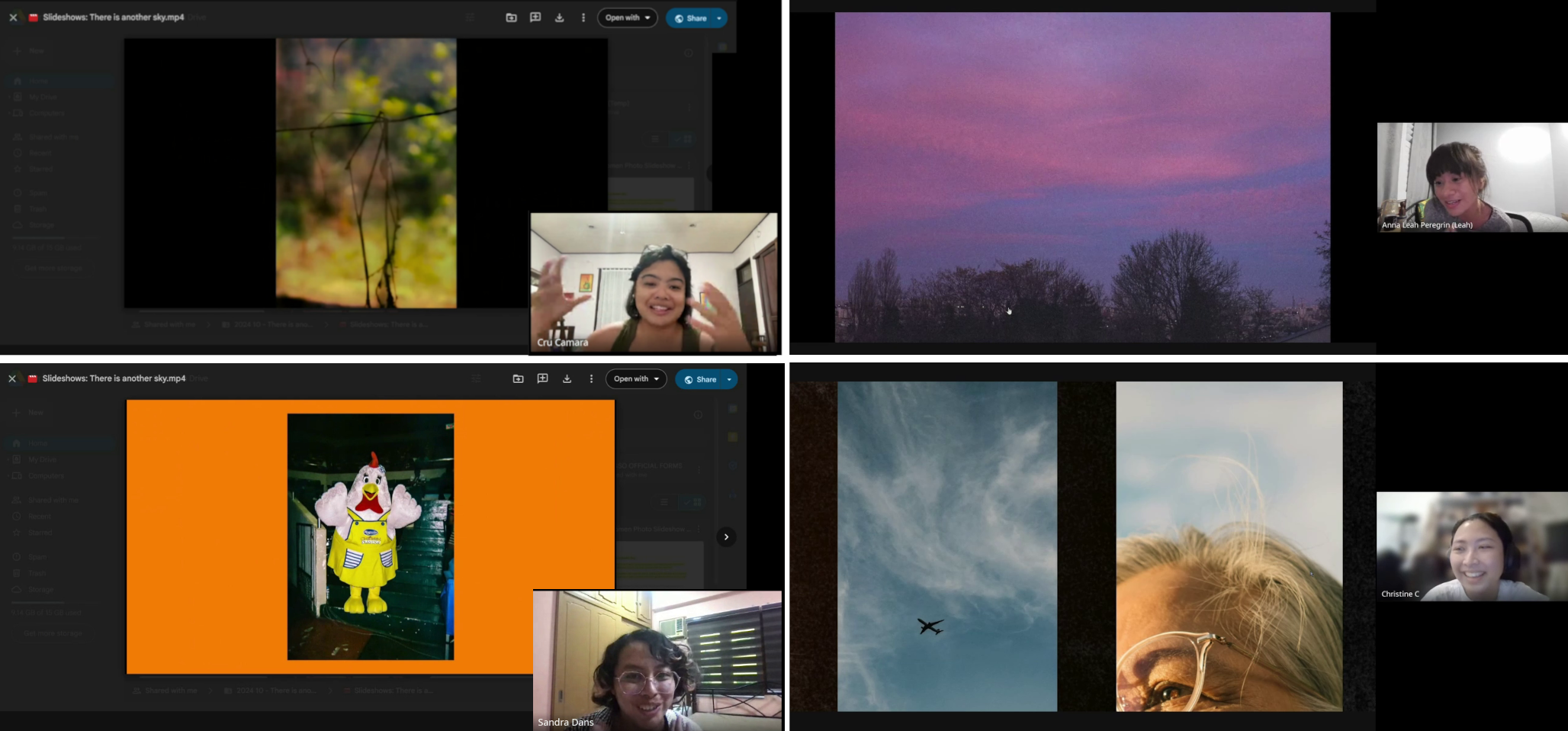
An edited screencap collage of the discussions. Clockwise from top left: Cru Camara against her slideshow, Leah De Leon against Geela Garcia’s slideshow, Christine Chung against Arabella Paner’s slideshow, and Sandra Dans against Tammy David’s slideshow.

Beginnings and mentors

the publishing industry, commercial client shoots in studios, or wedding and events photography. Leah De Leon, for example, graduated from DLSU College of Saint Benilde’s AB Photography armed with the intention of becoming a commercial photographer in landscape, travel, or high fashion genres, until she encountered Thousandfold. Wawi Navarroza’s artist-run photobook library, studio, and community space was active from 2015–2020 and was an early champion of community photography events like workshops, slideshows, and portfolio reviews. “[N]aintroduce kami sa panibago…kung paano mo ine-express yung photography in a different way…na parang, puwede nga pala ako mag-emote sa harap ng camera. May pinanghuhugutan na hindi lang siya…money-making tool.” Tammy David, who got her start in photojournalism and documentary photography, credits the late Romeo “Tata Romy” Gacad of Agence France-Presse and Nana Buxani, “one of the greatest living Filipino storytellers,” as her mentors. Meanwhile Arabella Paner, who started out in the publishing world “during its ‘golden era’,” was taught by people like Geric Cruz, Veejay Villafranca, Paolo Lorenzana, and Dennese Victoria—people whom she attests believed in the power of photography, her budding potential, and overall were “mga taong maniniwala sa trip mo.”

Commercial vs personal

As is commonplace in the industry, seven of the nine photographers (not all of whom identify as visual artists or lens-based artists) in There is another sky are freelancers. In the world of visual art—which crosses over to fashion, publication, literature, street culture, etc.—this also equates to being self-employed, leveraging your ‘personal brand’, and implicit participation in the “prestige machine.”2 Cru Camara, who, for the past 10 years has cemented a visually-arresting saturated style that she says is “at war with the general concept of photography,” struggles with translating personal expression into commercial use. While she’s shot plenty of editorial, food, and “stuff on white,” when she did commercial photography work, “I would literally tell people I'm like two different people.” She has since pulled back from commercial work; her slideshow we plant our feet where grief grows is a melancholy collection of photos taken during a time of transition when she and her partner were moving to Dumaguete, set to an atmospheric self-composed track. Photojournalist Geela Garcia, known for her coverage on women’s issues and the environment, likewise took the Flint slideshow space as a chance to let out the ‘in-between’ photos, the rests in between the action. “[W]hen you're doing documentary work, there's already a set shot list, and I'd like to think that the ones that are going to be eliminated from the shot list are the photographs that I took for this personal work.” Her film photos of European sky, clouds, and nature, The Clouds Look Different Here / Las nubes se ven diferentes aqui were taken during times of solitary contemplation and are “a creative outlet that’s more of me.”

Migration and limbo

Three of the nine photographers are based abroad: Leah De Leon in Canada, Tammy David in the US, and Aia Solis in Australia. Solis’s neither heaven nor hell “explores the quiet dissonance migration causes;” assembling a volley of photographs that advances with each note of a steadily crescendoing piano piece. “Everyone expects you to be happy, or thankful, or grateful because you're in a better place. Pero parang hindi siya nagtutugma sa nararamdaman mo,” says Solis, of the state of limbo she feels as a migrant eking out a living in New South Wales with her partner, who is also a photographer. In the face of total environmental change, the impulse to photograph becomes colored by the desire to safeguard anchors of identity—nostalgia, preserving memories, and documenting daily life.  

Interstitial practices

The Flint photo collective, initiated in 2023 by Angkor Photo Festival alumni James Lontoc, JL Javier, A.G. de Mesa, and Christine Chung, was formed to bring home what they felt was Angkor’s “special and communal” element: the workshop’s culminating slideshow presentation.3 Flint’s online activity is centered on Instagram—the page amplifies its members’ photo projects; announces calls for workshops, discussions, and project reviews; launches regular slideshow presentations; sells prints and zines; and most importantly, celebrates birthdays. But more than the slideshow, the burgeoning collective also cultivates a support system, an extra second wind when the momentum falls short, and a belief in “what photography could mean, more than look like.”4 

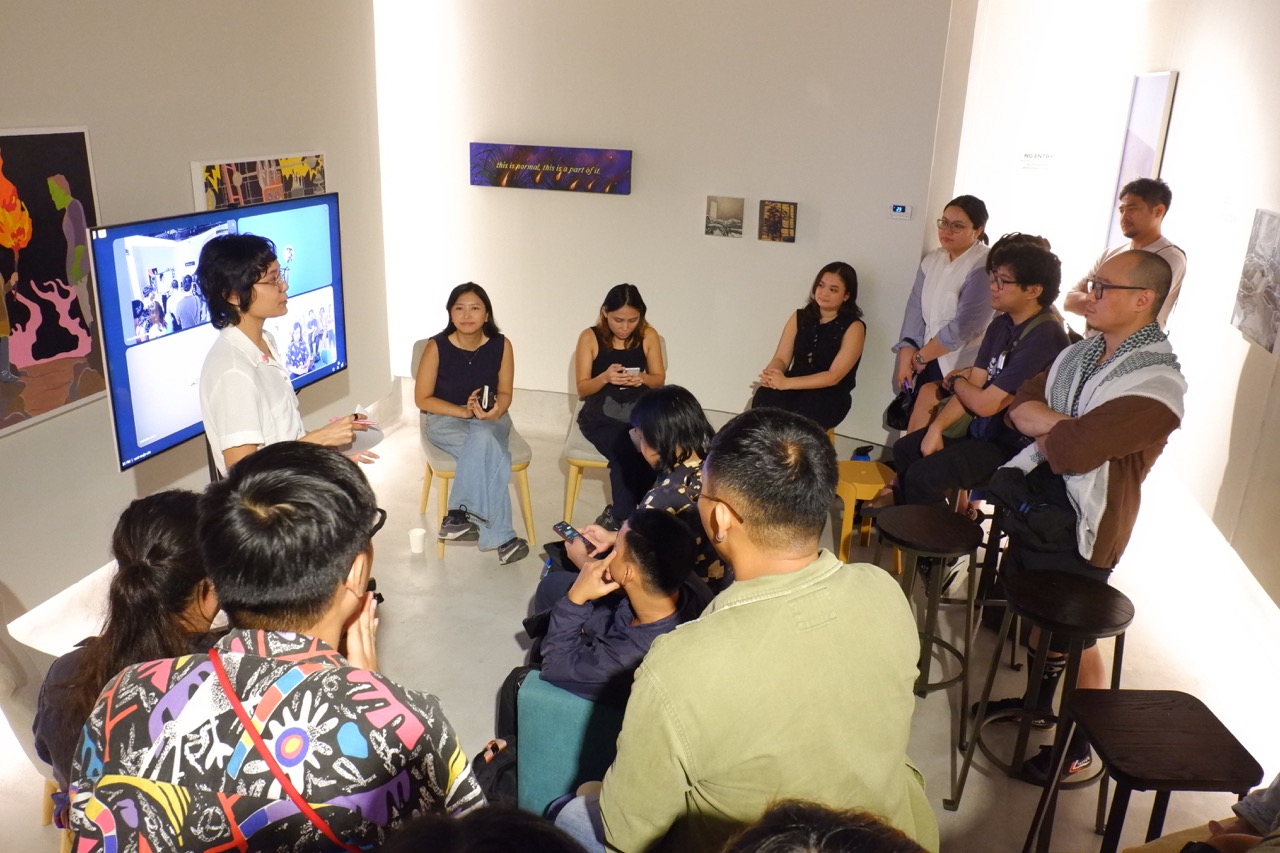
Moderator and author Kara de Guzman addresses the audience of the There is another sky event at Cartellino, November 2025. Courtesy of Jo Ivan Llaneta

Photography as projection, vulnerability

When photography emerged in the West in the mid-19th century it was conceived of in opposition to painting. Where the painted surface was an object, the painted sign material, photography instead was a projection, communication from a “presence ‘behind’ the picture” who was absent, a direct relay from human to human, or human to reality.5 When Burgin wrote this in Thinking Photography in the 80s, the conception of photography had become “dominated by a metaphor of depth” as an entry into more profound reality.6 Thus when photography prioritizes meaning over form, the implication is the further revelation of the photographer’s interior and exterior reality; a vulnerability with endless depth, or as Arabella put it, “nagsisinungaling ako [sa pagkuha ng photograph] kung hindi ko kinukutkot ang old wounds.” Flint and its members like Sandra Dans who believe in “engaging with photography as a lifestyle” produce photography in a way that is unremoved from daily life. Their collective resistance underscores as well the photography which it sets itself apart from: the excessive focus on formal elements like composition, light, and color, streamlined standards, and pre-established patterns of representation and consumption.

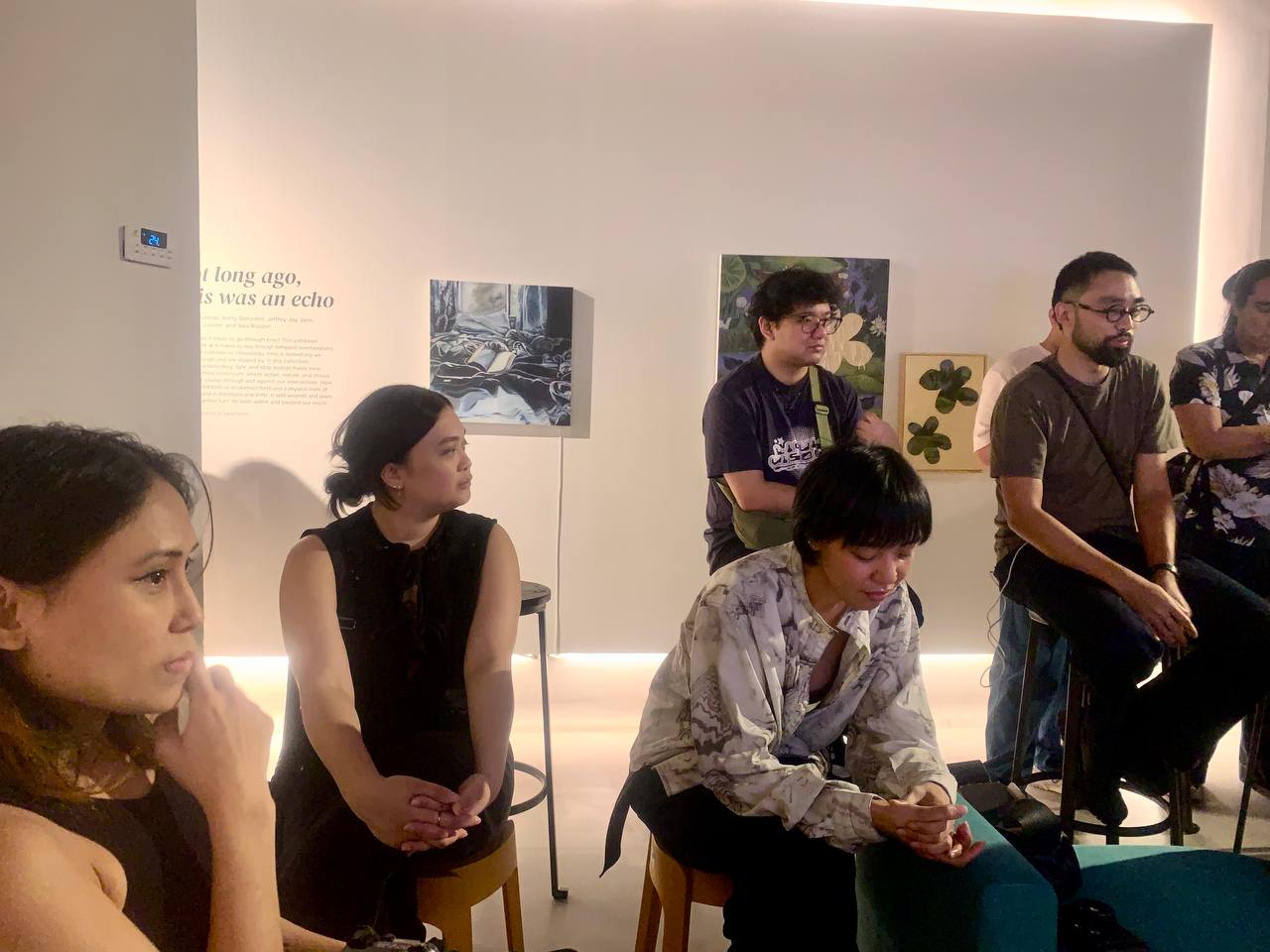
Co-founding member James Lontoc speaks from the audience during the Q&A at the second There is another sky event at Cartellino, November 2025. Courtesy of Christine Chung.

Interstitial means more freedom, more freedom means more mess

The photography slideshow, while nothing new, remains powerful for its format—a discrete experience defined by a duration of time, experienced collectively, sequentially and aurally controlled by the photographer, yet with enough breathing room for imaginative decoding, interpretation, and visual pleasure. There is another sky, like all of Flint’s slideshows, is not freely made available online in its entirety; the only way to view the presentation is to attend an in-person event. The scarcity is a deliberate choice, a demarcation from the barrage of images encountered in daily life that is offered (apparently) gratuitously. On the other hand, why make it harder to see photographs? Why make work that does not occupy cleanly delineated modes of consumption, even through platforms such as galleries or publications? Aside from prohibitive costs and the threat of unauthorized use as AI training data, specialized and intimate niches like Flint allow for “movement…into messy digressions.”7 The long-form slideshow allows for imperfection and experimentation, the singular printed photo unyoked by all that is at stake. As in the case of Ish Santillan who practiced photography with a flatbed photo scanner before having ever touched a handheld device; her slideshow Ang Sugo (The Messenger), composed of black and white scans and photographs, is a witness to her processing of trauma after leaving the Iglesia ni Cristo church. “Para siyang pagkagising mo sa umaga, tapos ‘yong senses mo, unti-unti pa lang siyang bumubukas,” says writer and freelance photographer Arabella Paner, of the feeling of taking photos after the death of her mother, whose life she had been documenting in a long-term photography project. She likens it to the feeling of pressing the bruise with water. Freeing, personal, and with no overarching intention, her photos of interstitial moments, nature, patches of skin, etc. are tender yearnings for rebirth.

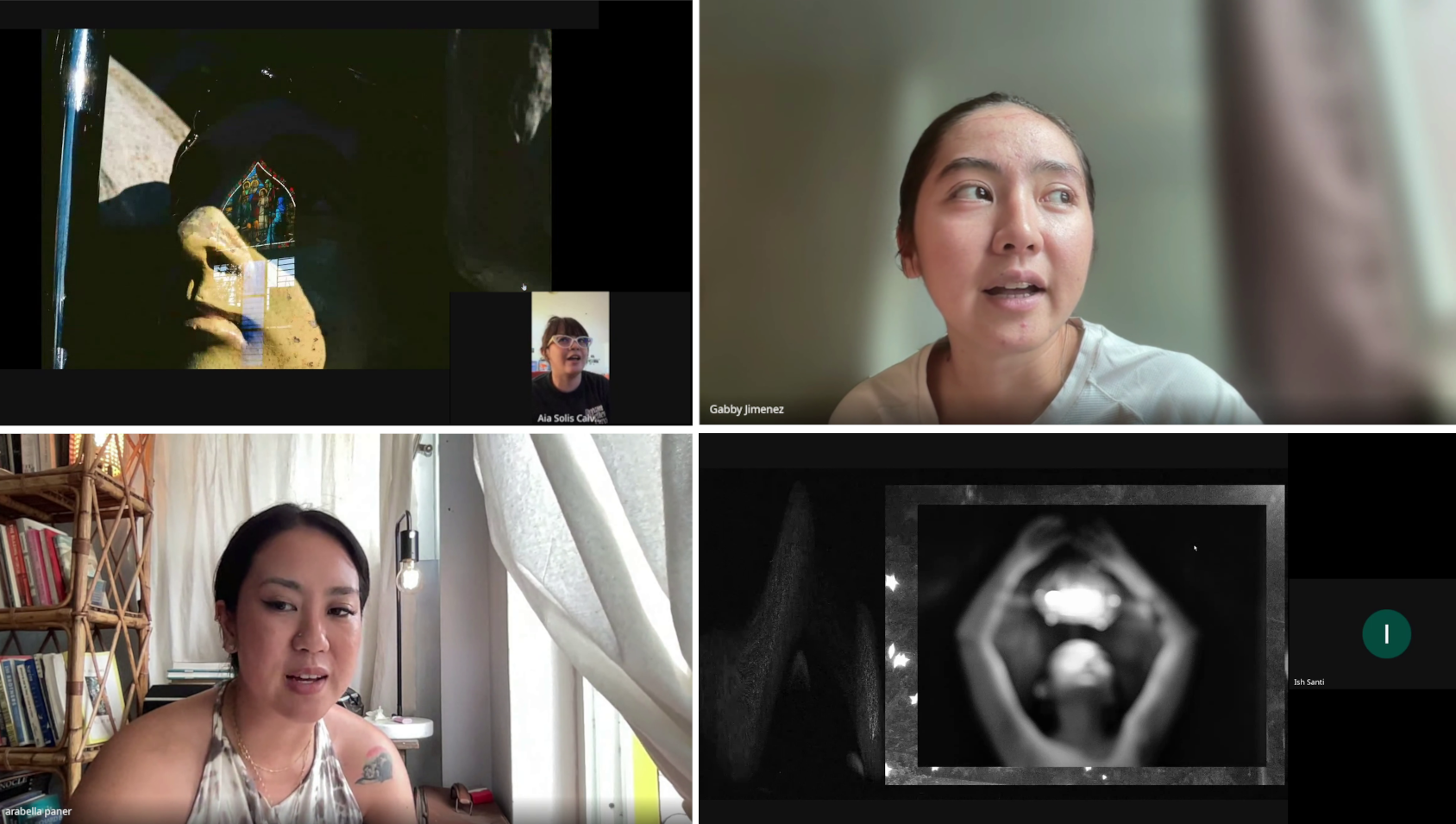
An edited screencap collage of the discussions. Clockwise from top left: Aia Solis against her slideshow, Gabby Jimenez, Ish Santillan’s slideshow, and Arabella Paner.

The feminist angle

I was invited to participate in There is another sky several months after its first showing and discussion event in Fotobaryo in November 2024. While well-attended by photography students who, like De Leon, were amazed by the possibility of long-form photography, the demographics left the collective dissatisfied by the lack of women’s perspective and audience. To practitioners this may come as no surprise; while the nine photographers Chung invited were all women, the world of professional photography is a male-dominated industry. This begs the question, what does There is another sky say about the state of women in photography, and is it a feminist endeavor?8 To some, the answer is easy—no, as it does not critique gender relations nor galvanize political action.9 Indeed, in the project’s namesake Emily Dickinson poem, the evergreen, unfading, and serene ‘other sky’ is – debatably – purely imaginary. Although an argument could be made for everyday feminism, which are “feminist actions [that] take place within individuals’ daily lives,” or quiet feminism which, amidst pervasive misogyny, is practiced in private circles.10 


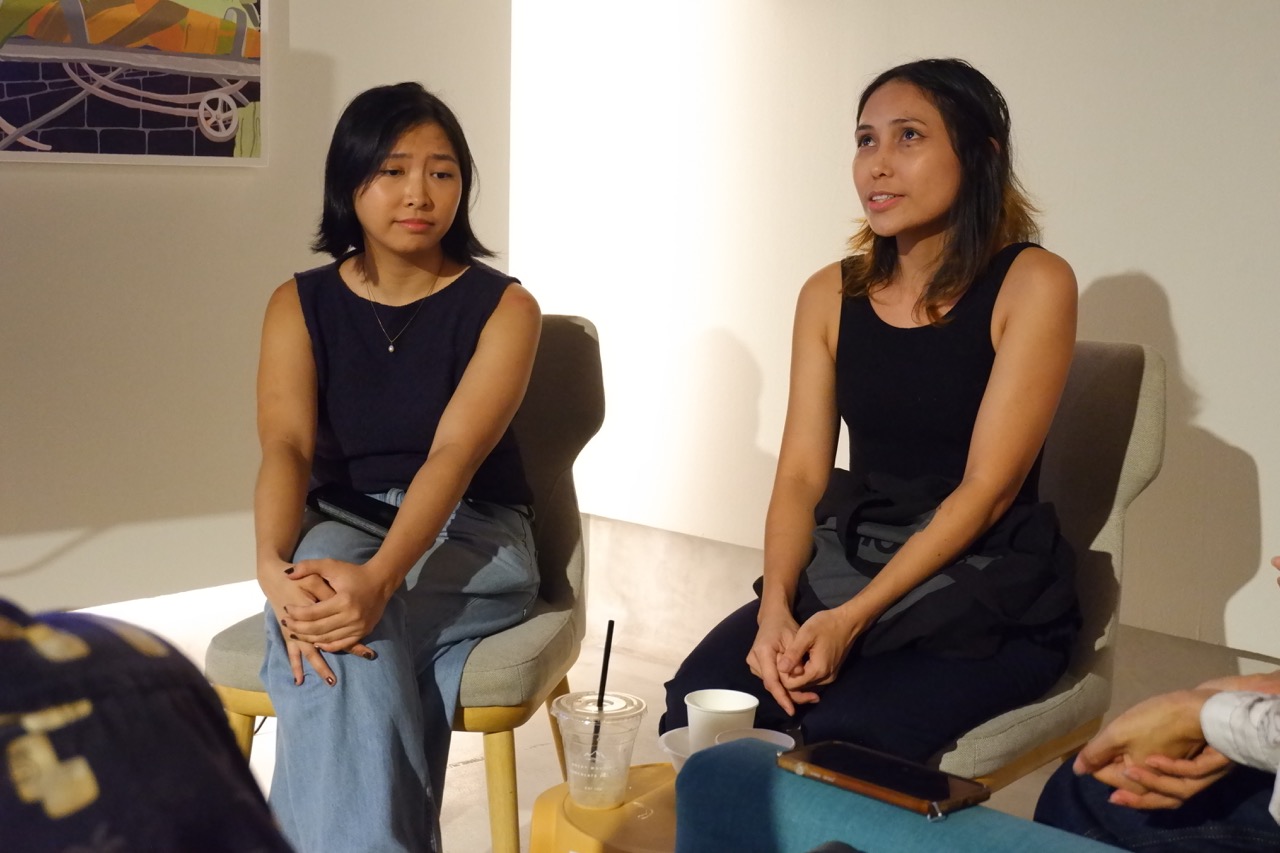
Curator Christine Chung (left) with participating photographer Ish Santillan (right) at the second There is another sky event at Cartellino, November 2025. Courtesy of Jo Ivan Llaneta

Not feminist but still radical

The radical proposition is, perhaps, in the treatment of photography as a tool—quotidian, instinctive, “kasama mo lang.”11 It is not necessary to flex a smorgasbord of cutting edge equipment, the narrow focus on which may preempt the possibility for mess (affectionate). Sandra, who was initiated into the industry via the “specific mold” of wedding photography, resisted against its predictable formulas by starting her own wedding photography outfit, but eventually shifted specialties entirely. However, her slideshow be weird af (honeybody) circles back to her old grind, telling a hopeful home movie-type story of Dans and her family around the time of the pandemic. Still, it shares the same operator as her creative work: “I believe in freedom, I believe in joy, I believe in moving towards things that bring you visual pleasure, especially as Filipinos, especially as women, or members of other marginalized communities. Moving towards things that bring us joy when we create is a form of rebellion, it is reclaiming visual spaces or visual practices that might have been imposed on us as we were learning.”

The photo is not all that, but it is plenty

Ultimately, the medium of photography is unlike painting or sculpture. It is too tied up into the language of the everyday: “news-photographs help transform the raw continuum of historical flux into the product 'news', domestic snapshots characteristically serve to legitimate (sic) the institution of the family, and so on.”12 Then what might be the social act which grounds personal / experimental / lens-based artistic photography? To take from Burgin again, he argues that the very moment a viewer encounters a photograph, its depicted scene is invested with full being; the possibility of it not existing is “instantaneously, unselfconsciously, [and] 'naturally' [refused] in favour of an imaginary plenitude.”13 In this sense, the slideshows which were answers to “what does it mean to remain whole in a world that feels fractured?” regardless of whether the nine women do, indeed, feel whole are subconsciously read to exist; perhaps not at that exact moment, but somewhere, somehow. Thus, and perhaps overly romantically, I conclude that these photographs literally manifest a whole, evergreen, and hopeful sky.

After this article was written, There is another sky was shown again at an intimate gathering at Couch Club, Pasig, last March 27, and as a guerrilla public projection in partnership with Dakila artist-activist group at Commune Cafe, Makati, last March 28, 2026.

Kara de Guzman is a Manila-based art writer, exhibitions manager, and cultural worker with experience in commercial and academic arts institutions. She graduated from Ateneo de Manila with a Management degree and is completing a masters in Art Studies at the UP Diliman—synthesizing her interest in the Philippine art market, its various agents, and their complex interplays.

Author's notes

[1] Gabby Jimenez, in discussion with the author, November 21, 2025.

[2]  Use of the term “prestige machine” is from Lyra Garcellano, “Prestige Machines and Performance Anxieties in the Age of the Economy of Recognition,” Ctrl+P Journal of Contemporary Art No. 19 (December 2019): 50–56, ISSN 1908-9805, https://www.ctrlp--artjournal.org/uploads/4/2/9/8/42984941/ctrlp_issue19.pdf.

[3] Christine Chung, in conversation with the author, August 5, 2025.

[4] A.G. de Mesa, during the There is another sky slideshow and discussion, Cartellino, Mandaluyong City, November 22, 2025.

[5] Victor Burgin (ed.), Thinking Photography. (London: Macmillan, 1982), 10.

[6] Burgin, 11.

[7] Pastor Roces, Marian. “Crystal Palace Exhibitions.” In Gathering: Political Writing on Art and Culture (Singapore: NUS Press, 2020), 239 .

[8] Thanks to Bienyl Huelgas (@analogdiwata) of Sachet Projects who spoke with me on this topic during the second slideshow event at Cartellino in December 2025.

[9] Julia Schuster, “Why the Personal Remained Political: Comparing Second and Third Wave Perspectives on Everyday Feminism.” Social Movement Studies 16, no. 6 (2017).

[10] Gowoon Jung and Minyoung Moon,“‘I Am A Feminist, But…’ Practicing Quiet Feminism in the Era of Everyday Backlash in South Korea,” Gender & Society 38 no. 2

[11]  Arabella Paner, in discussion with the author, November 11, 2025.

[12] Burgin, 144.

[13] Burgin, 144.

All quotations, unless otherwise specified, are taken from personal discussions with the photographers.

[order] => 0 [type] => blog_post [status] => published [created] => 2026-03-30 12:01:55 [modified] => 2026-04-08 11:49:27 [post_date] => 2026-04-08 11:01:00 [category_id] => 0 [parent_id] => 4 [parent_slug] => features [parent_title] => Features [author_id] => 46 [author_name] => KARA DE GUZMAN [first_name] => The Cartellino [last_name] => Team [username] => cartellino.art [nickname] => The Cartellino Team [metadata] => a:28:{s:10:"page_title";s:109:"

this Sky Is Plenty: Digesting Flint’s Photo Slideshow there Is Another Sky

";s:4:"tags";s:0:"";s:10:"source_url";s:0:"";s:7:"excerpt";s:0:"";s:11:"readability";s:0:"";s:14:"social_excerpt";s:0:"";s:5:"quote";s:0:"";s:11:"post_footer";s:0:"";s:13:"featured_post";s:1:"1";s:17:"featured_category";s:0:"";s:15:"featured_slider";s:0:"";s:14:"featured_quote";s:0:"";s:7:"comment";s:1:"1";s:10:"post_image";s:52:"uploads/2026/03/d37e2e88ca55bd426ad1e49e1341aa0c.JPG";s:11:"post_image2";s:52:"uploads/2026/03/d3b5331a31d67c7a4d3f6a340abe7e60.JPG";s:11:"post_image3";s:53:"uploads/2026/03/a1dac7374162bca97201764366d1bdad.jpeg";s:9:"post_type";s:0:"";s:11:"artist_name";s:0:"";s:13:"duration_from";s:0:"";s:11:"duration_to";s:0:"";s:17:"short_description";s:0:"";s:12:"artist_label";s:16:"About the Artist";s:16:"about_the_artist";s:0:"";s:14:"catalogue_link";s:0:"";s:14:"featured_works";s:0:"";s:11:"author_name";s:14:"KARA DE GUZMAN";s:15:"event_date_from";s:19:"2026-04-08 11:49:27";s:13:"event_date_to";s:19:"2026-04-08 11:49:27";} [category_title] => [category_slug] => )

This sky is plenty: Digesting Flint’s photo slideshow There is another sky

“And then there are also times that I'd rather not take the shot.”1

Cycling a cumulative 1,900 kilometers in Siargao, Bohol, Cavite, and Subic in a single Audax season, Gabby Jimenez pushes both mind and body to the limit. Occasionally stopping to rest, refuel, and take stock of what could be considered the extreme extent of a ‘photo walk’, she savors the landscape for its sheer visual pleasure, and just once in a while, does not take the shot.

Jimenez’s Pulse and Pause is one of the nine photography slideshows in There is another sky programmed by the Manila-based photo collective Flint. Curated in 2024 by Flint co-founder Christine Chung, the slideshows are the answers of nine women photographers to Christine’s question-prompt: “What does it mean to remain whole in a world that feels fractured? In the midst of chaos and disarray, where—or how—do you find your anchor?” Sparked by her experience of the intense yet commonplace trauma dealt by circumstances of capitalism, globalization, and migration, Chung curated a diverse cast of fellow photographers whom she admired, and whose answers could assuage her own doubts. This included University of the Philippines fine arts professor Sandra Dans, editorial photographer Cru Camara, musician and music event organizer Ish Santillan, freelance photographer, poet, and writer Arabella Paner, New York-based content strategist and occasional viral storyteller Tammy David, Australia-based photo poet Aia Solis, Canada-based multimedia artist Leah De Leon, graphic designer and cyclist Gabby Jimenez, and award-winning photojournalist Geela Garcia.

Etic-ette: an observer’s thoughts on the thing

In seeking to extend the lifespan of There is another sky and seek new avenues of engagement for its programming, I was brought on by Flint co-founder James Lontoc as moderator, writer, and overall outsider after its first screening at Fotobaryo in 2024. Five private Google Meet calls and a second screening at Cartellino later, I round up my observations.

An edited screencap collage of the discussions. Clockwise from top left: Cru Camara against her slideshow, Leah De Leon against Geela Garcia’s slideshow, Christine Chung against Arabella Paner’s slideshow, and Sandra Dans against Tammy David’s slideshow.

Beginnings and mentors

the publishing industry, commercial client shoots in studios, or wedding and events photography. Leah De Leon, for example, graduated from DLSU College of Saint Benilde’s AB Photography armed with the intention of becoming a commercial photographer in landscape, travel, or high fashion genres, until she encountered Thousandfold. Wawi Navarroza’s artist-run photobook library, studio, and community space was active from 2015–2020 and was an early champion of community photography events like workshops, slideshows, and portfolio reviews. “[N]aintroduce kami sa panibago…kung paano mo ine-express yung photography in a different way…na parang, puwede nga pala ako mag-emote sa harap ng camera. May pinanghuhugutan na hindi lang siya…money-making tool.” Tammy David, who got her start in photojournalism and documentary photography, credits the late Romeo “Tata Romy” Gacad of Agence France-Presse and Nana Buxani, “one of the greatest living Filipino storytellers,” as her mentors. Meanwhile Arabella Paner, who started out in the publishing world “during its ‘golden era’,” was taught by people like Geric Cruz, Veejay Villafranca, Paolo Lorenzana, and Dennese Victoria—people whom she attests believed in the power of photography, her budding potential, and overall were “mga taong maniniwala sa trip mo.”

Commercial vs personal

As is commonplace in the industry, seven of the nine photographers (not all of whom identify as visual artists or lens-based artists) in There is another sky are freelancers. In the world of visual art—which crosses over to fashion, publication, literature, street culture, etc.—this also equates to being self-employed, leveraging your ‘personal brand’, and implicit participation in the “prestige machine.”2 Cru Camara, who, for the past 10 years has cemented a visually-arresting saturated style that she says is “at war with the general concept of photography,” struggles with translating personal expression into commercial use. While she’s shot plenty of editorial, food, and “stuff on white,” when she did commercial photography work, “I would literally tell people I'm like two different people.” She has since pulled back from commercial work; her slideshow we plant our feet where grief grows is a melancholy collection of photos taken during a time of transition when she and her partner were moving to Dumaguete, set to an atmospheric self-composed track. Photojournalist Geela Garcia, known for her coverage on women’s issues and the environment, likewise took the Flint slideshow space as a chance to let out the ‘in-between’ photos, the rests in between the action. “[W]hen you're doing documentary work, there's already a set shot list, and I'd like to think that the ones that are going to be eliminated from the shot list are the photographs that I took for this personal work.” Her film photos of European sky, clouds, and nature, The Clouds Look Different Here / Las nubes se ven diferentes aqui were taken during times of solitary contemplation and are “a creative outlet that’s more of me.”

Migration and limbo

Three of the nine photographers are based abroad: Leah De Leon in Canada, Tammy David in the US, and Aia Solis in Australia. Solis’s neither heaven nor hell “explores the quiet dissonance migration causes;” assembling a volley of photographs that advances with each note of a steadily crescendoing piano piece. “Everyone expects you to be happy, or thankful, or grateful because you're in a better place. Pero parang hindi siya nagtutugma sa nararamdaman mo,” says Solis, of the state of limbo she feels as a migrant eking out a living in New South Wales with her partner, who is also a photographer. In the face of total environmental change, the impulse to photograph becomes colored by the desire to safeguard anchors of identity—nostalgia, preserving memories, and documenting daily life.  

Interstitial practices

The Flint photo collective, initiated in 2023 by Angkor Photo Festival alumni James Lontoc, JL Javier, A.G. de Mesa, and Christine Chung, was formed to bring home what they felt was Angkor’s “special and communal” element: the workshop’s culminating slideshow presentation.3 Flint’s online activity is centered on Instagram—the page amplifies its members’ photo projects; announces calls for workshops, discussions, and project reviews; launches regular slideshow presentations; sells prints and zines; and most importantly, celebrates birthdays. But more than the slideshow, the burgeoning collective also cultivates a support system, an extra second wind when the momentum falls short, and a belief in “what photography could mean, more than look like.”4 

Moderator and author Kara de Guzman addresses the audience of the There is another sky event at Cartellino, November 2025. Courtesy of Jo Ivan Llaneta

Photography as projection, vulnerability

When photography emerged in the West in the mid-19th century it was conceived of in opposition to painting. Where the painted surface was an object, the painted sign material, photography instead was a projection, communication from a “presence ‘behind’ the picture” who was absent, a direct relay from human to human, or human to reality.5 When Burgin wrote this in Thinking Photography in the 80s, the conception of photography had become “dominated by a metaphor of depth” as an entry into more profound reality.6 Thus when photography prioritizes meaning over form, the implication is the further revelation of the photographer’s interior and exterior reality; a vulnerability with endless depth, or as Arabella put it, “nagsisinungaling ako [sa pagkuha ng photograph] kung hindi ko kinukutkot ang old wounds.” Flint and its members like Sandra Dans who believe in “engaging with photography as a lifestyle” produce photography in a way that is unremoved from daily life. Their collective resistance underscores as well the photography which it sets itself apart from: the excessive focus on formal elements like composition, light, and color, streamlined standards, and pre-established patterns of representation and consumption.

Co-founding member James Lontoc speaks from the audience during the Q&A at the second There is another sky event at Cartellino, November 2025. Courtesy of Christine Chung.

Interstitial means more freedom, more freedom means more mess

The photography slideshow, while nothing new, remains powerful for its format—a discrete experience defined by a duration of time, experienced collectively, sequentially and aurally controlled by the photographer, yet with enough breathing room for imaginative decoding, interpretation, and visual pleasure. There is another sky, like all of Flint’s slideshows, is not freely made available online in its entirety; the only way to view the presentation is to attend an in-person event. The scarcity is a deliberate choice, a demarcation from the barrage of images encountered in daily life that is offered (apparently) gratuitously. On the other hand, why make it harder to see photographs? Why make work that does not occupy cleanly delineated modes of consumption, even through platforms such as galleries or publications? Aside from prohibitive costs and the threat of unauthorized use as AI training data, specialized and intimate niches like Flint allow for “movement…into messy digressions.”7 The long-form slideshow allows for imperfection and experimentation, the singular printed photo unyoked by all that is at stake. As in the case of Ish Santillan who practiced photography with a flatbed photo scanner before having ever touched a handheld device; her slideshow Ang Sugo (The Messenger), composed of black and white scans and photographs, is a witness to her processing of trauma after leaving the Iglesia ni Cristo church. “Para siyang pagkagising mo sa umaga, tapos ‘yong senses mo, unti-unti pa lang siyang bumubukas,” says writer and freelance photographer Arabella Paner, of the feeling of taking photos after the death of her mother, whose life she had been documenting in a long-term photography project. She likens it to the feeling of pressing the bruise with water. Freeing, personal, and with no overarching intention, her photos of interstitial moments, nature, patches of skin, etc. are tender yearnings for rebirth.

An edited screencap collage of the discussions. Clockwise from top left: Aia Solis against her slideshow, Gabby Jimenez, Ish Santillan’s slideshow, and Arabella Paner.

The feminist angle

I was invited to participate in There is another sky several months after its first showing and discussion event in Fotobaryo in November 2024. While well-attended by photography students who, like De Leon, were amazed by the possibility of long-form photography, the demographics left the collective dissatisfied by the lack of women’s perspective and audience. To practitioners this may come as no surprise; while the nine photographers Chung invited were all women, the world of professional photography is a male-dominated industry. This begs the question, what does There is another sky say about the state of women in photography, and is it a feminist endeavor?8 To some, the answer is easy—no, as it does not critique gender relations nor galvanize political action.9 Indeed, in the project’s namesake Emily Dickinson poem, the evergreen, unfading, and serene ‘other sky’ is – debatably – purely imaginary. Although an argument could be made for everyday feminism, which are “feminist actions [that] take place within individuals’ daily lives,” or quiet feminism which, amidst pervasive misogyny, is practiced in private circles.10 


Curator Christine Chung (left) with participating photographer Ish Santillan (right) at the second There is another sky event at Cartellino, November 2025. Courtesy of Jo Ivan Llaneta

Not feminist but still radical

The radical proposition is, perhaps, in the treatment of photography as a tool—quotidian, instinctive, “kasama mo lang.”11 It is not necessary to flex a smorgasbord of cutting edge equipment, the narrow focus on which may preempt the possibility for mess (affectionate). Sandra, who was initiated into the industry via the “specific mold” of wedding photography, resisted against its predictable formulas by starting her own wedding photography outfit, but eventually shifted specialties entirely. However, her slideshow be weird af (honeybody) circles back to her old grind, telling a hopeful home movie-type story of Dans and her family around the time of the pandemic. Still, it shares the same operator as her creative work: “I believe in freedom, I believe in joy, I believe in moving towards things that bring you visual pleasure, especially as Filipinos, especially as women, or members of other marginalized communities. Moving towards things that bring us joy when we create is a form of rebellion, it is reclaiming visual spaces or visual practices that might have been imposed on us as we were learning.”

The photo is not all that, but it is plenty

Ultimately, the medium of photography is unlike painting or sculpture. It is too tied up into the language of the everyday: “news-photographs help transform the raw continuum of historical flux into the product 'news', domestic snapshots characteristically serve to legitimate (sic) the institution of the family, and so on.”12 Then what might be the social act which grounds personal / experimental / lens-based artistic photography? To take from Burgin again, he argues that the very moment a viewer encounters a photograph, its depicted scene is invested with full being; the possibility of it not existing is “instantaneously, unselfconsciously, [and] 'naturally' [refused] in favour of an imaginary plenitude.”13 In this sense, the slideshows which were answers to “what does it mean to remain whole in a world that feels fractured?” regardless of whether the nine women do, indeed, feel whole are subconsciously read to exist; perhaps not at that exact moment, but somewhere, somehow. Thus, and perhaps overly romantically, I conclude that these photographs literally manifest a whole, evergreen, and hopeful sky.

After this article was written, There is another sky was shown again at an intimate gathering at Couch Club, Pasig, last March 27, and as a guerrilla public projection in partnership with Dakila artist-activist group at Commune Cafe, Makati, last March 28, 2026.

Kara de Guzman is a Manila-based art writer, exhibitions manager, and cultural worker with experience in commercial and academic arts institutions. She graduated from Ateneo de Manila with a Management degree and is completing a masters in Art Studies at the UP Diliman—synthesizing her interest in the Philippine art market, its various agents, and their complex interplays.

Author's notes

[1] Gabby Jimenez, in discussion with the author, November 21, 2025.

[2]  Use of the term “prestige machine” is from Lyra Garcellano, “Prestige Machines and Performance Anxieties in the Age of the Economy of Recognition,” Ctrl+P Journal of Contemporary Art No. 19 (December 2019): 50–56, ISSN 1908-9805, https://www.ctrlp--artjournal.org/uploads/4/2/9/8/42984941/ctrlp_issue19.pdf.

[3] Christine Chung, in conversation with the author, August 5, 2025.

[4] A.G. de Mesa, during the There is another sky slideshow and discussion, Cartellino, Mandaluyong City, November 22, 2025.

[5] Victor Burgin (ed.), Thinking Photography. (London: Macmillan, 1982), 10.

[6] Burgin, 11.

[7] Pastor Roces, Marian. “Crystal Palace Exhibitions.” In Gathering: Political Writing on Art and Culture (Singapore: NUS Press, 2020), 239 .

[8] Thanks to Bienyl Huelgas (@analogdiwata) of Sachet Projects who spoke with me on this topic during the second slideshow event at Cartellino in December 2025.

[9] Julia Schuster, “Why the Personal Remained Political: Comparing Second and Third Wave Perspectives on Everyday Feminism.” Social Movement Studies 16, no. 6 (2017).

[10] Gowoon Jung and Minyoung Moon,“‘I Am A Feminist, But…’ Practicing Quiet Feminism in the Era of Everyday Backlash in South Korea,” Gender & Society 38 no. 2

[11]  Arabella Paner, in discussion with the author, November 11, 2025.

[12] Burgin, 144.

[13] Burgin, 144.

All quotations, unless otherwise specified, are taken from personal discussions with the photographers.